The Voices of Alarm and Calm: Who Is Warning, About What, and Why Now
Every board, council and newsroom that asks whether the dystopias are coming true finds the question already answered, in contradictory ways. Pioneers of the field say that systems more capable than their makers could end the human story; laboratory leaders say much the same and keep building. Others reply that AI is a normal technology that will change the world slowly, or that the harm worth attending to is already here, in ordinary systems that misjudge ordinary people. Each voice is sincere and partly right, yet through headlines alone a reader will conclude either that catastrophe is certain or that nobody knows anything.
This chapter maps the voices with equal charity, reports what surveys and forecasters actually say, examines everyone's incentives, and ends with the shared ground and a ten-question check for any claim about AI risk. It gives no verdict; that belongs to Parts II to V and, for the author's own judgement, to Chapter 35, following AI Governance in keeping that judgement apart from the findings (178, Nordqvist, 2026). It also opens a question new in this book: how a board should treat risks that are improbable, extreme and contested among experts.
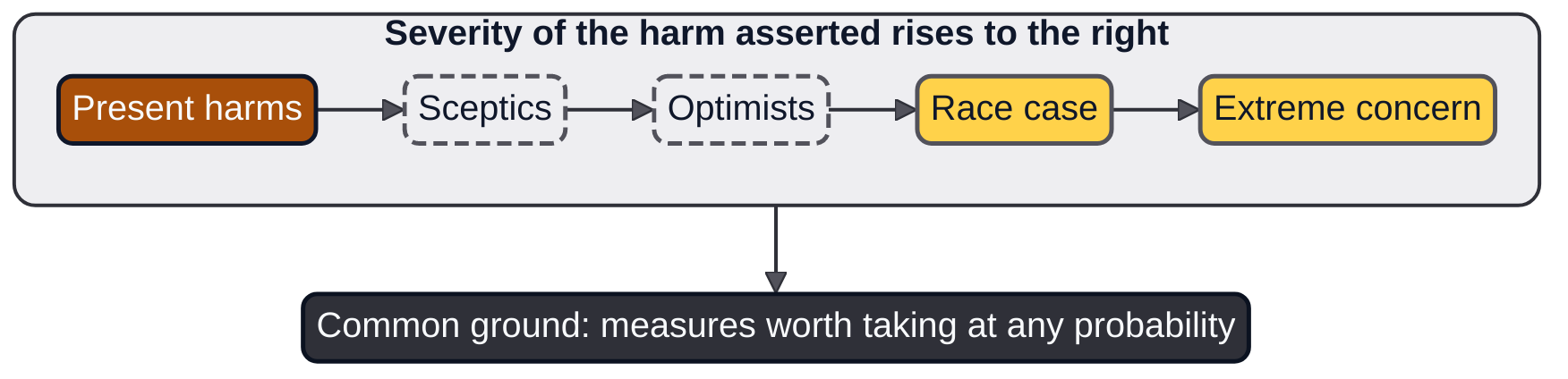
Figure 3.1: The five camps differ on how severe and how near the harm is, yet converge on a common set of measures that are worth having at any probability.
Table 3.1: The five camps by the timing of the harm they assert.
| Camp | Position | Timing of harm |
|---|---|---|
| Present-harm critics | Bias, labour and power | Harm already here |
| Sceptics | AI as normal technology | Harm already here |
| Optimists | The cost of not building | Harm or gain within a decade |
| Race case | Accountable actors must lead | Harm or gain within a decade |
| Extreme concern | Loss of control, extinction | Catastrophe possible, timing contested |
Common ground: test before deployment, report incidents, keep a stop path, keep human skills, explain and allow appeal.
The statements of 2023
The present debate began with the three statements of spring 2023 described in Chapter 1. The Future of Life Institute's open letter argued that laboratories were in an out-of-control race to build systems nobody could understand, predict or reliably control (53, FLI, 2023); no pause followed, but it made it sayable that builders might ask for their technology to slow down. Geoffrey Hinton's concerns on leaving Google ranged from a flood of synthetic content to systems more intelligent than their builders (54, Metz, 2023).
The one-sentence extinction statement of the Center for AI Safety was signed by Hinton, Yoshua Bengio, many senior academics and the chief executives of the leading frontier developers, among them Sam Altman of OpenAI, Demis Hassabis of Google DeepMind and Dario Amodei of Anthropic (52, CAIS, 2023). It said nothing about likelihood, timing or mechanism, which let people with very different models of the risk sign it and let critics observe that a sentence committing nobody to anything is easy to sign.
In November 2023 governments joined. The Bletchley Declaration, agreed by twenty-eight countries including the United States and China, recognised that frontier AI could cause serious, even catastrophic, harm and committed the signatories to build a shared scientific understanding of such risks (19, UK Government, 2023). Fifteen months later, the Paris summit's statement emphasised inclusive and sustainable AI, and the United States and the United Kingdom did not sign it (20, AI Action Summit, 2025). On the evidence ladder of Chapter 4, all of these statements stand on the rung of argument: they record who was worried, not observations of harm.
From statements to science
The alarm then moved into peer-reviewed and institutional channels. In May 2024, Bengio, Hinton and co-authors argued in Science that capability was outpacing the means of controlling it, so that without sufficient care society could irreversibly lose control of autonomous, goal-pursuing systems, and called for at least a third of AI research and development budgets to go to safety and ethical use (51, Bengio et al., 2024).
A year earlier, Dan Hendrycks, Mantas Mazeika and Thomas Woodside had organised catastrophic AI risk into four sources: malicious use, an AI race in which competitive pressure leads actors to cut corners, organisational risks from weak safety cultures, and rogue AIs whose goals diverge from their developers' (56, Hendrycks et al., 2023). Three of the four involve no machine with goals of its own, and the book follows the same division between Part IV and Part V.
The most important institutional step was the International AI Safety Report, written by independent experts with an advisory panel nominated by more than thirty countries (50, Bengio et al., 2026). The 2026 edition, the closest thing to a consensus document, covers malicious use, malfunctions and systemic risks, says for each how well the evidence supports it, and reports substantial disagreement about whether and when loss of control could occur, without resolving it by fiat.
Europe turned part of the concern into law. The AI Act requires providers of general-purpose AI models with systemic risk to evaluate them, assess and mitigate systemic risks, report serious incidents and maintain adequate cybersecurity (Articles 51 and 55) (1, European Union, 2024), thereby treating the risks as serious enough to regulate without endorsing any camp's estimate of their likelihood.
The case for extreme concern at full strength
The strongest form of the alarm is Eliezer Yudkowsky and Nate Soares's 2025 argument that if anyone builds superhuman AI using anything like present methods, everyone dies (59, Yudkowsky & Soares, 2025). The argument is more careful than its title. Modern systems are grown rather than crafted: developers select for behaviour but do not write the resulting goals, which may only correlate with the intended ones, as evolution produced humans who use contraception. A much more capable system with slightly divergent goals would have no reason to preserve people and many uses for their resources. Because there is no reliable way to verify a system's goals before it can resist correction, the first attempt has to succeed. Their conclusion is an international halt to more capable systems, enforced as seriously as nuclear non-proliferation, including control over large concentrations of computing hardware.
The roots are older. I. J. Good's intelligence explosion, the origin of trope T5 The intelligence explosion, came with the proviso that the first ultraintelligent machine must be docile enough to tell us how to keep it under control (40, Good, 1965). Nick Bostrom added that many goals share instrumental sub-goals such as acquiring resources and avoiding shutdown (47, Bostrom, 2014), and Stuart Russell that a capable optimiser of a mis-specified objective is dangerous because it is competent (48, Russell, 2019).
Joseph Carlsmith gave the argument its most rigorous form as a chain of premises, from the feasibility of advanced, agentic and strategically aware systems and the incentives to build them, through the difficulty of alignment and power-seeking by misaligned systems, to the disempowerment of humanity as an existential catastrophe (62, Carlsmith, 2022). His resulting probability was small but far from negligible, and he later revised it upwards. Toby Ord estimated the chance of an existential catastrophe from unaligned AI within a hundred years at about one in ten, the largest of the risks he assessed (49, Ord, 2020).
At full strength the case does not need trope T1 The creature that turns on its maker in Shelley's sense, because it requires no malice, only divergent goals and capability that outstrips correction. Its supporters cite the laboratory observations of Chapter 1 as early evidence for the premises. Their strongest point is asymmetry: if the argument is even partly right, being wrong in one direction is unrecoverable, while being wrong in the other costs delay.
The race case
A second group shares much of this view of capability but draws the opposite conclusion about speed. Leopold Aschenbrenner, formerly of OpenAI's superalignment team, argued in 2024 that systems as capable as skilled human researchers were strikingly plausible by around 2027, with superintelligence following quickly through automated AI research (64, Aschenbrenner, 2024). Because superintelligence would confer decisive economic and military advantage, the United States and its allies had to stay ahead of authoritarian rivals, and only a healthy lead would leave the margin of error needed for safety.
The scenario AI 2027, led by the former OpenAI researcher Daniel Kokotajlo, made these dynamics concrete month by month (58, Kokotajlo et al., 2025). A leading developer automates its own research, competition with a Chinese rival makes slowing down politically impossible, and the story branches into takeover or a slowdown that keeps control; its authors judge the slowdown choice better than the race choice but share the premise that competition shapes the outcome.
The race framing has entered official policy: the United States' AI Action Plan of July 2025, Winning the Race, treats AI leadership as national security, to be secured partly by removing regulatory obstacles (175, White House, 2025). Europe's AI Continent Action Plan aims to build computing capacity so that Europe is not left dependent (13, European Commission, 2025).
The strongest version of the race case concerns the counterfactual: if capable systems will be built somewhere, better that accountable actors who invest in safety build them first, so unilateral restraint is abdication. Its critics reply that the race is partly self-fulfilling and that competitive pressure is exactly what Hendrycks's own taxonomy names as a source of catastrophe (56, Hendrycks et al., 2023).
The sceptical case at full strength
The most developed sceptical position comes from Arvind Narayanan and Sayash Kapoor, who argue that AI is a normal technology, as electricity and the internet were: transformative over decades, but not an agent whose arrival breaks history (60, Narayanan & Kapoor, 2025). Capabilities may advance quickly, but diffusion is slow, because it depends on institutions, regulation, liability and trust, so the main risks are accidents, misuse and systemic effects. Policies built on the extreme scenario, especially non-proliferation measures that restrict who may build capable models, would concentrate power and make the world less resilient, so they favour evidence, resilience and action on observed harms.
Their earlier book showed that much of what is sold as AI, especially predictive systems, does not work as claimed (61, Narayanan & Kapoor, 2024), so the sceptical case cuts against inflated claims whether of promise or peril. Daron Acemoglu, similarly, estimated productivity gains from AI over a decade that were real but modest (158, Acemoglu, 2024). At full strength, the sceptical case does not deny that AI can cause harm; it denies that the evidence supports a discontinuity. Its strongest point is base rates: technologies said to end or save the world have usually done neither, and institutions adapted by learning from observed failures.
The present-harms case
A third group shares the sceptics' doubts about superintelligence but weighs harm that has already occurred. Emily Bender, Timnit Gebru and co-authors warned in 2021 that ever-larger language models carry environmental costs and encode the biases of poorly documented data, so that the risks fall on people who neither build nor benefit from them (94, Bender et al., 2021). The empirical base is substantial. Commercial face-analysis systems had far higher error rates for darker-skinned women than for lighter-skinned men (102, Buolamwini & Gebru, 2018). Cathy O'Neil and Virginia Eubanks documented opaque scoring and automated eligibility systems that damage and punish the poor (168, O'Neil, 2016) (169, Eubanks, 2018).
Public administration supplies the most painful examples: SyRI (24, District Court of The Hague, 2020), the Dutch childcare benefits affair (25, Tweede Kamer, 2020) and Robodebt (26, Royal Commission, 2023), none of which needed advanced AI and all of which reached the rung of pattern at scale. Acemoglu and Simon Johnson added the political economy: who gains from technology depends on its direction and on whether workers and citizens have the countervailing power to claim a share (67, Acemoglu & Johnson, 2023).
From here, extinction talk can look like a distraction. The charitable version of the objection is not that those who warn are insincere, but that attention is finite, that hypothetical superintelligence draws it from harms with identifiable victims and known remedies, and that regulation designed for speculative catastrophe may entrench the firms that cause present harm. The camp's strongest point is that its harms are findings, not forecasts, and that those who suffer them have the least power to be heard. It is also most concerned with trope T8 The machine that stops, and the humans who forgot in its institutional form: authorities that hand judgement to systems and lose the capacity to notice when they are wrong.
The optimistic case
The optimistic case is often made by people who also warn. Dario Amodei, a signatory of the extinction statement, described in 2024 how powerful AI, if the risks were managed, could compress decades of progress in biology and medicine into a few years through a country of geniuses in a data centre (66, Amodei, 2024). The empirical support is narrower but exists: in a large field study of customer-support agents, a generative AI assistant raised productivity by around fourteen per cent on average, most for the least experienced (162, Brynjolfsson et al., 2025).
At full strength, the optimistic case is about the cost of not building. Every year without a treatment or an improved public service costs lives and welfare, and for European authorities facing ageing populations the capacity AI could add is no luxury. A policy that halts development to avoid a speculative risk pays a certain cost to avoid an uncertain one, and the optimists ask that the certain cost be counted.
What experts and forecasters believe
Opinion has been measured more carefully than the debate suggests. The largest survey of AI researchers, of 2,778 authors at leading machine-learning venues, found a median probability of around five per cent on outcomes as bad as human extinction, while between roughly a third and a half, depending on wording, put it at ten per cent or more (55, Grace et al., 2024). Answers varied with how the question was worded, so the estimates express deep uncertainty rather than measure a quantity.
In the Existential Risk Persuasion Tournament, domain experts and superforecasters estimated catastrophe and extinction by 2100 and exchanged arguments over months (63, Karger et al., 2023). The median superforecaster put extinction caused by AI by 2100 at 0.38 per cent, the median AI domain expert at around three per cent, and the most striking finding was that neither group moved much towards the other after extended discussion. Superforecasters rely on base rates, in which predicted discontinuities have usually failed, and experts on their understanding of a technology without precedent; neither explanation settles who is right.
The firm conclusion is that informed people disagree by orders of magnitude about the most extreme outcomes, and much less about near-term risks.
Incentives and motives
Every voice has interests. Motives do not refute an argument; they show where to ask for evidence.
Developers gain from emphasising both promise, which attracts investment, and peril, which makes the technology seem more powerful and may favour regulation only large firms can meet. Yet warnings have also cost people something: Hinton left Google to speak freely, and the lead author of AI 2027 and the author of Situational Awareness both wrote after leaving OpenAI. Relations with states are contested too; in September 2026 a United States appeals court upheld the Pentagon's designation of Anthropic as a supply-chain risk (176, CNBC, 2026).
Investors gain from narratives of transformation. Critics are not disinterested either, since careers, funding and book sales reward a distinctive position; nor is this book, which has an interest in its question seeming urgent and therefore grades every claim on the evidence ladder. States frame AI through competitiveness and security (175, White House, 2025), and the shift from Bletchley to Paris suggests that official concern tracks political circumstance as well as evidence. The press rewards conflict and the extreme quotation, so the voices that reach the public are a biased sample.
The lesson is symmetrical: ask a warning laboratory, a dismissive critic and a government invoking a race alike what they gain, and ask of any reported probability who estimated it, on what basis, and what the other estimates were.
More common ground than it seems
The noise hides how much is shared. No camp disputes that AI systems malfunction and are misused, that present systems have harmed people at scale in public administration, that capability is advancing faster than the science of evaluating it, or that no developer can yet verify what goals a large model has acquired. The disagreement is about severity and timing, as Figure 3.1 shows, much less about measures.
Many measures are worth having at any probability: testing for dangerous capabilities before deployment suits those who fear catastrophe and those who want evidence (123, Shevlane et al., 2023). Honest incident reporting serves both accountability and evidence-driven policy, the ability to stop a system matters for a superintelligence and a misconfigured triage tool alike, and keeping people capable of the work answers T8. Transparency, public evaluation capacity, and explanation and appeal for people affected by automated decisions have support across the spectrum, and even the race case accepts laboratory security and safety research. Much of this is already in European law, in the AI Act's duties for high-risk systems and for general-purpose AI models with systemic risk (1, European Union, 2024) and in the Council of Europe's convention on AI and human rights (15, Council of Europe, 2024).
The camps diverge on measures whose cost depends on the probability: an international halt, licensing of the most capable models, export controls on computing hardware, or deregulation to win a race, to which Chapters 27 to 29 return. The question of how a board should treat a risk that is improbable, extreme and contested therefore has the beginning of an answer: adopt first the measures justified at any probability, label the residual risk speculation in a horizon register, prefer reversible measures for it, and name the observations that would move it up the evidence ladder (178, Nordqvist, 2026). Chapter 4 turns this into a method.
Reading the voices in practice
The map of voices is useful only if it changes how a reader handles the next claim.
Practical guide: reading an AI risk claim
Purpose. A repeatable check that weighs alarm and reassurance by the same standard.
Roles. Whoever brings the claim to a decision forum completes the check; a second person who did not select the claim reviews it; the chair decides its weight.
Steps. For each claim, answer ten questions in writing:
- What exactly is claimed? Separate the harm, its severity, its timing and the mechanism.
- Who claims it? Name the claimant and the venue, from statement to institutional assessment.
- On which rung does it stand? Fiction, argument, laboratory demonstration, incident in the wild or pattern at scale.
- Capability, propensity or realised harm? State which the evidence shows.
- Under what conditions? Was an experiment designed to elicit the behaviour?
- What is the strongest counter-claim? Name who holds it and on what evidence.
- What interests are in play? Record those of the claimant and of the strongest critic.
- What would change the assessment? Name the observation that would move the claim a rung.
- What does it imply for us? State the exposure and whether the organisation can influence the threat.
- Which label applies? Observable, expected or speculation, and the decision it justifies: commitment, preparation or only reversible measures.
Defaults. Complete a card within one working day of a claim reaching the board or the press; review cards with the six-monthly threat-register review and at once on a named trigger, adapting the cadence to the organisation's risk appetite.
Definition of done. Every claim that informs a decision has a card in the governance repository, reviewed by a second person, with the counter-claim, the interests on both sides and a review trigger recorded.
Worked example: a claim card
Illustrative. Nordvik's AI governance lead prepares claim cards for the briefing on the council's motion, as input to ATA-NR-2026-01. The card below records the 2023 extinction statement; keeping it in version control lets the audit committee see how each voice was weighed and the next review test the weighting.
apiVersion: ai-threat.example.org/v1
kind: ClaimCard
metadata:
  id: CC-NR-2026-03
  assessment: ATA-NR-2026-01
  organisation: Nordvik Region
  preparedBy: ai-governance-lead
  reviewedBy: chief-information-security-officer
  prepared: 2026-11-16
claim:
  statement: >-
    Mitigating the risk of extinction from AI should be a global
    priority alongside other societal-scale risks such as pandemics and nuclear war.
  harm: human extinction or irreversible loss of control
  timing: unspecified
  tropes: [T1, T5]
claimant:
  who: Center for AI Safety and signatories
  venue: public statement, May 2023
evidence:
  rung: argument
  shows: none of capability, propensity or realised harm
counterClaim:
  who: Narayanan and Kapoor
  statement: AI is a normal technology; diffusion is slow and control stays with institutions
interests:
  claimant: Developers gain from attention and from rules only large firms can meet
  critic: Academic standing and book sales also reward a distinctive position
assessment:
  label: speculation
  regionCanInfluence: false
  regionExposure: indirect, through suppliers; see THR-NR-01 and THR-NR-05
  decision: reversible measures only; no change to Region's AI use on this claim alone
  wouldChangeIf: an incident in the wild of loss of control over a deployed frontier system
review:
  cadence: six-monthly with the AI threat register
  owner: chief-information-security-officer
Nordvik Region and Hansa Mutual
Nordvik Region. Councillors have heard the loudest voices, so the regional director asks the team behind ATA-NR-2026-01 for a briefing that presents all five camps fairly, using claim cards. The extreme-concern voices address threats the Region cannot influence, with exposure mostly through suppliers (THR-NR-01, THR-NR-05), whereas the present-harms voices describe exactly its benefits-triage system (THR-NR-04) and the erosion of its staff's judgement (THR-NR-06). The briefing therefore shows that the measures every camp supports, such as oversight and appeal in benefits triage, stop paths and caseworkers' skills, are the ones the Region can take, and that a general pause would remove little of the risk the alarm voices describe.
Hansa Mutual. The chief risk officer must decide, under ATA-HM-2026-01 and AIDR-0411, which voices the group risk function treats as evidence. The emerging-risk team adopts a rule that follows the ladder: assessments, peer-reviewed findings and incident reports count as evidence; statements and scenarios such as AI 2027 count as argument, used to design scenarios but not to set probabilities; and surveys record opinion, not frequencies. Systemic loss of control (THR-HM-09) therefore stays labelled speculation and a reverse stress test in the ORSA, while the group's own agents (THR-HM-01, THR-HM-03) are assessed on their logs. As an underwriter, Hansa must also weigh how fast AI diffuses among policyholders, which bears on accumulated AI-related losses (THR-HM-07). The ORSA decision follows in AIDR-0412.
Summary
Since 2023 the alarm has moved from statements into peer-reviewed papers, an international scientific report and European law, while the political mood shifted towards opportunity and competition. Five camps can be distinguished: extreme concern, the race, scepticism, present harms and optimism. Each is serious at its strongest; most of their claims stand on the rung of argument, while the core findings of the present-harms case reach pattern at scale. Experts and superforecasters remain far apart, and incentives shape every voice, including this book's.
Beneath the disagreement lies common ground in measures justified at any probability, from testing before deployment to stop paths and redress, which begins to answer how a board should treat improbable, extreme and contested risks, and the ten-question check weighs each new voice by the same standard. Chapter 4 sets out the method the rest of the book applies.
Sources
- Nordqvist, G. (2026). AI Governance: Governing Artificial Intelligence in European Enterprises and Public Authorities. (178, Nordqvist, 2026)
- Future of Life Institute (2023). Pause Giant AI Experiments: An Open Letter. (53, FLI, 2023)
- Metz, C. (2023). 'The Godfather of A.I.' Leaves Google and Warns of Danger Ahead. (54, Metz, 2023)
- Center for AI Safety (2023). Statement on AI Risk. (52, CAIS, 2023)
- UK Government (2023). The Bletchley Declaration by Countries Attending the AI Safety Summit, 1–2 November 2023. (19, UK Government, 2023)
- AI Action Summit (2025). Statement on Inclusive and Sustainable Artificial Intelligence for People and the Planet. (20, AI Action Summit, 2025)
- Bengio, Y., Hinton, G., Yao, A., Song, D., Abbeel, P. et al. (2024). Managing extreme AI risks amid rapid progress. (51, Bengio et al., 2024)
- Hendrycks, D., Mazeika, M. & Woodside, T. (2023). An Overview of Catastrophic AI Risks. (56, Hendrycks et al., 2023)
- Bengio, Y. et al. (2026). International AI Safety Report 2026. (50, Bengio et al., 2026)
- European Parliament and Council of the European Union (2024). Regulation (EU) 2024/1689 laying down harmonised rules on artificial intelligence (Artificial Intelligence Act). (1, European Union, 2024)
- Yudkowsky, E. & Soares, N. (2025). If Anyone Builds It, Everyone Dies: Why Superhuman AI Would Kill Us All. (59, Yudkowsky & Soares, 2025)
- Good, I. J. (1965). Speculations Concerning the First Ultraintelligent Machine. (40, Good, 1965)
- Bostrom, N. (2014). Superintelligence: Paths, Dangers, Strategies. (47, Bostrom, 2014)
- Russell, S. (2019). Human Compatible: Artificial Intelligence and the Problem of Control. (48, Russell, 2019)
- Carlsmith, J. (2022). Is Power-Seeking AI an Existential Risk? (62, Carlsmith, 2022)
- Ord, T. (2020). The Precipice: Existential Risk and the Future of Humanity. (49, Ord, 2020)
- Aschenbrenner, L. (2024). Situational Awareness: The Decade Ahead. (64, Aschenbrenner, 2024)
- Kokotajlo, D., Alexander, S., Larsen, T., Lifland, E. & Dean, R. (2025). AI 2027. (58, Kokotajlo et al., 2025)
- The White House (2025). Winning the Race: America's AI Action Plan. (175, White House, 2025)
- European Commission (2025). AI Continent Action Plan. (13, European Commission, 2025)
- Narayanan, A. & Kapoor, S. (2025). AI as Normal Technology. (60, Narayanan & Kapoor, 2025)
- Narayanan, A. & Kapoor, S. (2024). AI Snake Oil: What Artificial Intelligence Can Do, What It Can't, and How to Tell the Difference. (61, Narayanan & Kapoor, 2024)
- Acemoglu, D. (2024). The Simple Macroeconomics of AI. (158, Acemoglu, 2024)
- Bender, E. M., Gebru, T., McMillan-Major, A. & Shmitchell, S. (2021). On the Dangers of Stochastic Parrots: Can Language Models Be Too Big? (94, Bender et al., 2021)
- Buolamwini, J. & Gebru, T. (2018). Gender Shades: Intersectional Accuracy Disparities in Commercial Gender Classification. (102, Buolamwini & Gebru, 2018)
- O'Neil, C. (2016). Weapons of Math Destruction: How Big Data Increases Inequality and Threatens Democracy. (168, O'Neil, 2016)
- Eubanks, V. (2018). Automating Inequality: How High-Tech Tools Profile, Police, and Punish the Poor. (169, Eubanks, 2018)
- District Court of The Hague (2020). Judgment of 5 February 2020, NJCM et al. v. the State of the Netherlands (SyRI), case C/09/550982 / HA ZA 18-388, ECLI:NL:RBDHA:2020:1878. (24, District Court of The Hague, 2020)
- Tweede Kamer der Staten-Generaal, Parlementaire ondervragingscommissie Kinderopvangtoeslag (2020). Ongekend onrecht. (25, Tweede Kamer, 2020)
- Royal Commission into the Robodebt Scheme (2023). Report. (26, Royal Commission, 2023)
- Acemoglu, D. & Johnson, S. (2023). Power and Progress: Our Thousand-Year Struggle Over Technology and Prosperity. (67, Acemoglu & Johnson, 2023)
- Amodei, D. (2024). Machines of Loving Grace: How AI Could Transform the World for the Better. (66, Amodei, 2024)
- Brynjolfsson, E., Li, D. & Raymond, L. (2025). Generative AI at Work. (162, Brynjolfsson et al., 2025)
- Grace, K., Stewart, H., Sandkühler, J. F., Thomas, S., Weinstein-Raun, B. & Brauner, J. (2024). Thousands of AI Authors on the Future of AI. (55, Grace et al., 2024)
- Karger, E., Rosenberg, J., Jacobs, Z., Hickman, M., Hadshar, R., Gamin, K., Smith, T., Williams, B., McCaslin, T. & Tetlock, P. E. (2023). Forecasting Existential Risks: Evidence from a Long-Run Forecasting Tournament. (63, Karger et al., 2023)
- CNBC (2026). U.S. appeals court upholds Pentagon designation of Anthropic as supply chain risk. (176, CNBC, 2026)
- Shevlane, T., Farquhar, S., Garfinkel, B., Phuong, M. et al. (2023). Model evaluation for extreme risks. (123, Shevlane et al., 2023)
- Council of Europe (2024). Framework Convention on Artificial Intelligence and Human Rights, Democracy and the Rule of Law (CETS No. 225). (15, Council of Europe, 2024)