Work, Skills and the Ironies of Automation
The play that gave the world the word "robot" is about work. Karel Čapek's R.U.R. imagines artificial workers manufactured because they are cheaper than people, a world economy that comes to depend on them, and a human race that loses first its purpose and then its existence (35, Čapek, 1920). A century later the fear has two forms. The first is obsolescence: machines that write, analyse and decide will leave large numbers of people with no work. The second is quieter and closer to E. M. Forster's story of the machine that stopped (33, Forster, 1909): the work remains, but the people who remain become supervisors of systems they no longer understand, and lose the skills they would need on the day the system fails.
This chapter tests T8 The machine that stops, and the humans who forgot at the scale of work. Chapter 6 examined the trope in the individual mind and Chapter 7 in education; this chapter takes the organisational view, from exposure and productivity to the ironies of automation, rubber-stamping and the redesign of work. Every governance arrangement in the series rests on human judgement, so if that judgement erodes, oversight becomes a formality.
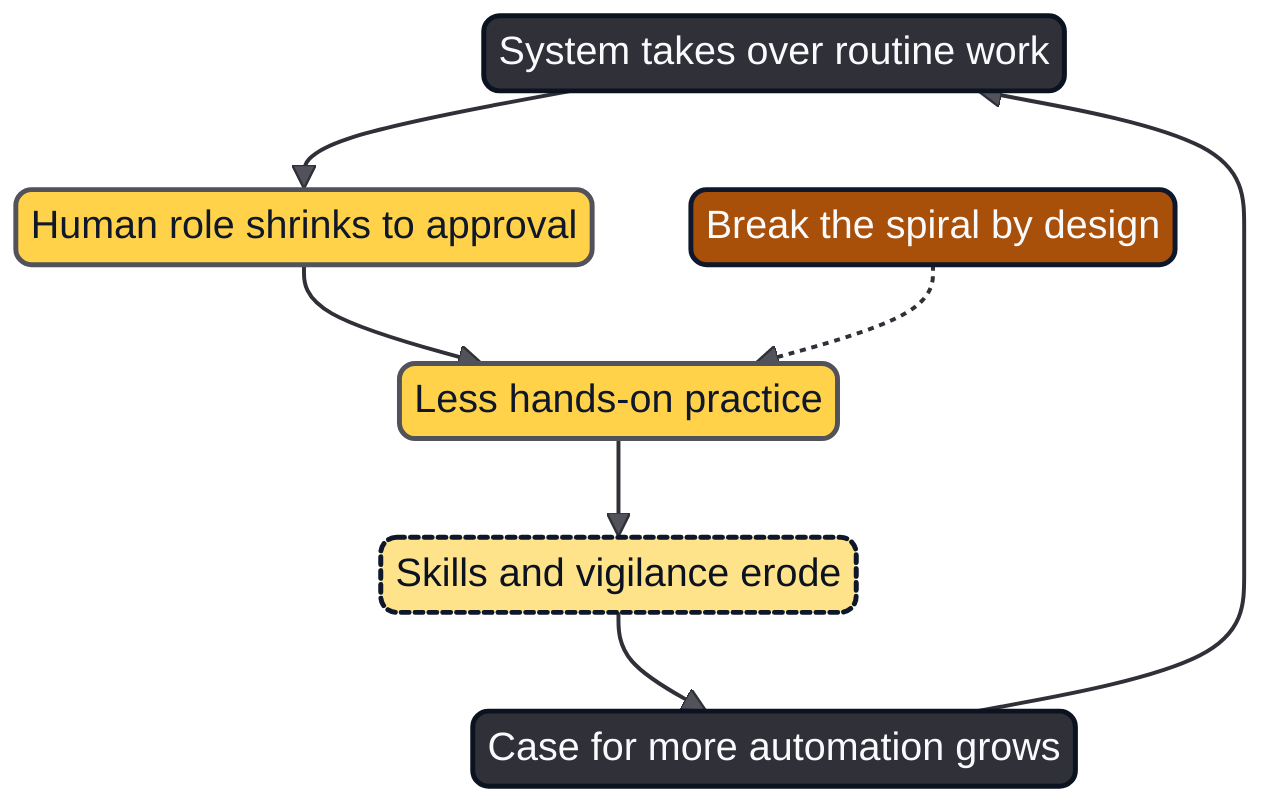
Figure 14.1: The automation spiral; each turn of the loop is reasonable on its own, which is why it has to be interrupted by design.
Table 14.1: Ways to break the spiral.
| Intervention | Acts on |
|---|---|
| Rotation into unaided casework | Less hands-on practice |
| Seeded-error drills | Erosion of skills and vigilance |
| Tested manual fallback | Erosion of skills and vigilance; the rare hard case |
| Oversight-quality metric | Faster approvals and more reliance |
| Work redesigned with workers and works councils | The shrinking of the human role |
Exposure is not replacement
Most public claims about AI and jobs rest on exposure indices, which break occupations into tasks, judge whether a language model could perform or substantially speed up each one, and aggregate the result. Tyna Eloundou and colleagues found that around 80 per cent of the United States workforce could have at least a tenth of their tasks affected by large language models, and around a fifth at least half (157, Eloundou et al., 2024). Staff of the International Monetary Fund estimated that around 40 per cent of global employment, and around 60 per cent in advanced economies, is exposed to AI (161, Cazzaniga et al., 2024). The International Labour Organization's refined global index placed roughly one job in four in occupations with some exposure to generative AI, found clerical work the most exposed, with exposure higher in high-income countries and for women (159, Gmyrek et al., 2025).
These numbers are routinely quoted as if they measured jobs lost, but they measure where the technology could touch work, not what employers will do. The IMF staff found roughly half of exposed jobs in advanced economies likely to be complemented by AI, because the work involves responsibility, physical presence or high stakes, and half more likely to be substituted (161, Cazzaniga et al., 2024), and the ILO concluded that most exposed occupations are more likely to be transformed than automated (159, Gmyrek et al., 2025). Moreover, the indices judge tasks as described, not as performed, and say nothing about time or about whether a task will be automated to cut headcount or augmented. What they show reliably is where change will concentrate: in cognitive, office and clerical work, and disproportionately at the start of a career.
The productivity evidence
Measured effects are so far more modest and uneven than either the promise or the fear. Erik Brynjolfsson, Danielle Li and Lindsey Raymond studied the staggered introduction of an AI assistant among more than five thousand customer-support agents (162, Brynjolfsson et al., 2025). Issues resolved per hour rose by about 14 per cent on average and by about a third for novice and less-skilled agents, while the most experienced agents gained little and showed some signs of slightly lower quality; newer agents also reached competence faster, and fewer agents left. The assistant moved the practices of the best agents to the rest, and those whose practices were captured received little of the benefit.
At the level of the economy, Daron Acemoglu estimated with a task-based model that AI would raise total factor productivity in the United States by well under one per cent over ten years (158, Acemoglu, 2024), because early gains come from easy tasks with measurable success. The International AI Safety Report records that economists disagree on the magnitude of future impacts (50, Bengio et al., 2026), so organisations should plan for a range rather than a number.
Inside organisations, adoption has proved harder than demonstrations suggest. Preliminary findings from MIT's NANDA initiative in 2025, whose sampling has been questioned, reported that the large majority of enterprise generative AI pilots examined had produced no measurable return (160, Challapally et al., 2025), and Gartner predicted that over 40 per cent of agentic AI projects would be cancelled by the end of 2027, citing cost, unclear value and inadequate risk controls (163, Gartner, 2025). There is no evidence yet of AI-driven unemployment across whole economies, and Arvind Narayanan and Sayash Kapoor's account of AI as a normal technology whose effects arrive through diffusion over decades fits the evidence better than predictions of a collapse of work (60, Narayanan & Kapoor, 2025). It says nothing, however, about the quality of the work that remains.
The ironies of automation
In 1983 Lisanne Bainbridge, a psychologist who studied operators of industrial processes, published Ironies of automation, which named consequences that follow from the logic of automation itself (164, Bainbridge, 1983). Chapter 2 introduced it as the engineering form of T8, and each irony has a counterpart in AI-assisted knowledge work.
The first irony concerns the designer: automation is introduced because operators are considered unreliable, yet the designer automates what can be automated and leaves the operator an arbitrary residue rather than a designed job. In generative AI the residue is whatever the model cannot be trusted with, which shifts with every model version and is rarely written down. The second concerns skill: manual and cognitive skills deteriorate when unused, so an operator who has only monitored a process for years takes over more slowly and less competently, least practised at the moment of greatest need.
The third irony concerns monitoring. People are poor at maintaining vigilance over a process in which little happens, and checking a system requires the knowledge the automation has stopped them from exercising. The fourth concerns the hardest cases: automation hands abnormal situations to people with less practice than ever, so that, as Bainbridge concluded, the more advanced the automation, the more crucial and demanding the remaining human contribution may become, while a job reduced to watching is likely to be experienced as deskilled. Her remedies remain the starting point: regular manual control, simulators for abnormal situations, displays that support understanding, and more demanding training for intervention.
Generative AI sharpens the ironies, because its outputs are fluent, so a wrong answer looks like a right one, and because it moves the residue upwards, leaving caseworkers, claims handlers and analysts with the judgement calls of a domain whose understanding they built through the routine work now automated.
Deskilling and rubber-stamping
Bainbridge's ironies predict a specific failure in AI oversight. When a system proposes and a person approves, the approval rate rises and the time per approval falls as people learn that the system is usually right, until the approval records that a person was present, not that a person judged. AI Governance, Chapters 10 and 21, concluded that human oversight must be designed, not declared, with an interruption path, an override log and the authority to use them, and that approvals given in seconds signal rubber-stamping (178, Nordqvist, 2026). This chapter adds the mechanism: rubber-stamping is the expected end state of oversight that is not designed to keep the overseer practised.
The evidence of deference to fluent machine output is consistent. In the survey of knowledge workers by Hao-Ping Lee and colleagues, higher confidence in generative AI was associated with less critical thinking (85, Lee et al., 2025), and students who practised with an unrestricted assistant performed worse once it was removed (87, Bastani et al., 2025). Public administration offers a harsher lesson: the Australian Robodebt scheme raised welfare debts by automated income averaging with little human examination of individual cases, and the Royal Commission found it neither fair nor legal (26, Royal Commission, 2023). No advanced AI was involved; what failed was the human judgement that should have stood between a calculation and a citizen.
Architecture as Code (Chapter 20) set out the rule "agents draft; humans approve", and its conclusion (Chapter 27) left open how AI-proposed change is reviewed when the reviewer depends on the AI (177, Nordqvist, 2025). This chapter's partial answer is that soundness can be reviewed only by someone who still practises the underlying task, and that the organisation can measure whether its reviewers still catch errors. Article 14 of the AI Act likewise requires high-risk systems to keep overseers aware of automation bias, and Article 26 requires deployers to assign oversight to people with the necessary competence, training and authority (1, European Union, 2024).
How oversight quality is measured matters. Approval time alone is a poor signal, since a quick approval of an obvious case is good practice. The informative measures compare what reviewers do with what the system actually gets wrong, and test reviewers directly by inserting known-wrong proposals, as airport security has long done to keep baggage screeners alert.
Redesigning work
The alternative to the spiral in Figure 14.1 is not to refuse automation but to design the human role deliberately. Four principles follow. Rotation: people who oversee a system spend a defined part of their time doing the work unaided, on real cases. Practice of the abnormal: Bainbridge's simulators become drills built from past incidents and difficult cases, including deliberately seeded errors. A manual fallback that is used: a procedure never run is a hope, so a share of normal volume runs without the system at regular intervals. Meaningful tasks: a job combining complex cases, contact with the people affected, improvement of the system and oversight of its routine output is one people can be good at and want to keep.
These principles cost time, and the cost belongs in the business case. Daron Acemoglu and Simon Johnson argue that the gains of new technology have historically been shared widely only when workers and institutions had the power to shape its use, and that technology chosen mainly to cut labour costs can produce "so-so automation", which displaces workers without large productivity gains (67, Acemoglu & Johnson, 2023). Chapter 15 examines the argument at the scale of society; at the scale of the organisation it implies that the people who do the work should take part in its redesign.
European labour law gives that participation a formal channel. Article 26(7) of the AI Act requires employers to inform workers' representatives and affected workers before putting a high-risk AI system into service at the workplace, and Annex III, point 4, classifies systems that allocate tasks based on individual behaviour or personal traits, or monitor and evaluate workers' performance and behaviour, as high-risk (1, European Union, 2024); Article 88 of the GDPR allows member states to set more specific rules for employees' data (6, European Union, 2016). German and Dutch works councils have co-determination and consent rights over monitoring systems, and Nordic unions consultation rights. A metric that observes how employees approve proposals is therefore itself a monitoring system that must be designed for consultation, and works councils know how the work is actually done.
Practical guide: Keeping oversight skills alive
Purpose. Keep the people who oversee an AI system able to recognise and correct its errors, and to do the work without it, for as long as the system runs.
Roles. The AI system owner is accountable, team leads run rotation and drills, the oversight officer under AI Governance, Chapter 14, owns the metric (178, Nordqvist, 2026), workers' representatives are consulted, and the owner of the AI threat register (Chapter 32) receives the results.
Steps.
- Map the oversight-critical skills, the two to four skills a reviewer needs to recognise a wrong proposal, and the cases in which the system is known to be weak. Default: before go-live and with each new model version.
- Consult before measuring. Present the plan to workers' representatives, state in writing that results are reported at team level and never used for individual performance evaluation, and record the outcome per entity or site.
- Set a rotation. Default: at least one working day in ten, or ten per cent of volume, handled without the system's proposal.
- Run seeded-error drills. Default: one in 250 reviewed proposals is a known-wrong synthetic item, never executed and revealed to the reviewer afterwards with feedback.
- Test the manual fallback one day per quarter, measuring throughput, error rate and what the team lacked.
- Protect time and authority to override. Make overriding as quick to record as approving, and never treat a justified override as a performance problem.
- Measure oversight quality monthly, at team level, with the metric below.
- Act on signals with refresher drills and a review of thresholds and workload, recording the finding in the threat register; treat a cause in workload or targets as a management finding, not a training need.
- Review every six months and on a new model version, a change of autonomy, an incident or a reorganisation.
Definition of done. Skills are mapped, consultation is recorded, rotation and fallback days have run at least twice, seeded drills run continuously, and the metric reaches the register owner monthly. Teams whose decisions affect benefits or claims need stricter defaults than those reviewing internal correspondence.
Worked example: An oversight-quality metric that detects rubber-stamping
The following definition is illustrative. It belongs to Hansa Mutual's claims-triage agent (AIDR-0024), whose routes for claims above its approval rules are confirmed by handlers at the Polish service centre, and supplies evidence for THR-HM-08 (erosion of claims-handling skills) and THR-HM-01 (the agent acting beyond its approval rules).
oversight_quality_metric:
  id: OQM-HM-CLM-01
  status: illustrative
  decision_record: AIDR-0024
  threat_register_entries: [THR-HM-08, THR-HM-01]
  owner: claims operations lead, Polish service centre
  privacy_and_codetermination:
    unit_of_analysis: team
    minimum_group_size: 8
    individual_reporting: prohibited
    use_in_performance_evaluation: prohibited
    consultation_record_required_before_go_live: [DE, NL, SE, PL]
    group_policy_with_local_consultation: [NO, UK, CH]
  signals:
    - id: seeded_detection_rate
      description: share of seeded known-wrong routes that reviewers reject or escalate
      alert_below: 0.85
    - id: override_to_error_ratio
      description: reviewer override rate divided by agent error rate in the monthly quality sample
      alert_below: 0.5
      alert_above: 3.0
    - id: fast_approval_share
      description: share of complex-claim approvals given in under 15 seconds
      alert_above: 0.30
    - id: fallback_drill_accuracy
      description: share of claims routed correctly on the quarterly day without the agent
      alert_below: 0.90
  rubber_stamping_suspected_when:
    all_of: [fast_approval_share]
    any_of: [seeded_detection_rate, override_to_error_ratio]
    window: one calendar month
  response:
    - schedule refresher drills within 30 days
    - review workload, targets and agent thresholds
    - record finding against THR-HM-08
The thresholds are starting points, not research findings; the design choices matter more. No single signal decides: a fast approval is suspicious only when the same team also misses seeded errors or overrides far less often than the agent is wrong, and a ratio that is too high is also a finding, suggesting distrust of a well-performing system or a degraded agent. The aggregation rule and consultation records are part of the metric, because without them it would become the workplace monitoring that Annex III, point 4, and co-determination law treat with particular care.
The debate
The case for concern
The case for concern begins with what is new. Earlier automation took over physical and routine clerical tasks, and displaced people could often move into cognitive work; generative AI is aimed at cognitive work itself. It touches most occupations, concentrated on office, clerical and professional tasks (157, Eloundou et al., 2024) (159, Gmyrek et al., 2025), and the IMF staff warned that without deliberate policy AI is likely to widen inequality, because the gains accrue to those who can complement it and to the owners of capital (161, Cazzaniga et al., 2024). It is enough that change outruns the capacity of people, firms and welfare systems to adapt.
Within the workplace, the best field study shows the largest gains for novices because the assistant spreads the know-how of the most skilled workers (162, Brynjolfsson et al., 2025), which, read with Acemoglu and Johnson, transfers expertise from workers to whoever owns the system (67, Acemoglu & Johnson, 2023). Even where jobs remain, the human role is hollowed out into monitoring (164, Bainbridge, 1983), and because generative AI automates the tasks through which people learn, the next generation may never acquire the skills (Chapter 7). The endpoint is Forster's, an organisation that runs on systems no one inside it could replace or question (33, Forster, 1909).
The case for calm
The case for calm begins with the historical record. Over two centuries of mechanisation and computerisation, technology repeatedly destroyed particular jobs while total work and living standards rose, because unforeseen tasks, products and occupations emerged; exposure estimates for earlier technologies did not lead to a collapse of employment. Disruption, on this view, is not obsolescence.
The evidence itself supports calm. Gains are largest for less experienced workers, which narrows performance differences and gives new entrants a faster route to competence (162, Brynjolfsson et al., 2025); macroeconomic estimates are modest (158, Acemoglu, 2024), which also implies modest disruption; and enterprise adoption has been slow and uneven (160, Challapally et al., 2025) (163, Gartner, 2025). On Narayanan and Kapoor's account that slowness is the normal pattern of a general-purpose technology and gives institutions time to adapt (60, Narayanan & Kapoor, 2025). Finally, Bainbridge's analysis did not end automation in process control or aviation but led to better design, simulator training and procedures, remedies that are cheaper in knowledge work and that the law already requires through oversight designed for automation bias (1, European Union, 2024). Deskilling is a design failure to be engineered against, not a destiny.
Where the positions meet
Both positions accept that exposure is not replacement, that measured gains are real but uneven and largest for novices, that macroeconomic effects remain uncertain, and that automation leaving people only to monitor erodes their ability to intervene. Above all, both agree that the distribution of gains and the design of the remaining human role are choices: whether a task is automated to cut costs or augmented to raise quality, whether reviewers stay practised, and whether workers take part in the redesign are decided by managers, boards, works councils, unions and legislators.
What can be done
Individuals can invest in the skills that oversight depends on, namely judgement in context, dealing with people and the domain knowledge needed to recognise a wrong answer, and keep practising the core tasks of their profession unaided. Chapter 31 develops these habits.
Organisations can design the human role rather than leave it as a residue, with rotation, drills, a tested fallback and an oversight-quality metric recorded in the AI threat register (Chapter 32), involve workers and works councils from the start, and count the cost of keeping oversight real in the business case. Chapter 30 places these measures among the organisational defences.
Society can invest in transition support and lifelong learning, fund long-term research on skills and job quality, and treat the competence of human overseers as part of the conformity of high-risk systems.
Verdict on the trope
T8 The machine that stops, and the humans who forgot, at the scale of work, divides into three claims. That automation erodes the skills of the people left to supervise it reaches pattern at scale for ordinary automation, since Bainbridge's ironies were drawn from operating experience and have shaped decades of practice (164, Bainbridge, 1983). For generative AI in knowledge work the same claim reaches laboratory demonstration at most, through experiments and surveys showing reduced checking and unaided performance, and its outlook is expected wherever junior tasks are automated and oversight is not designed for engagement. Oversight becoming a formality has reached incident in the wild in public administration through ordinary automation, as Robodebt showed. The stronger claim, that AI will make human work obsolete, rests on argument and exposure estimates; measured employment effects are limited, and mass obsolescence is speculation.
What can be influenced is almost everything that decides the outcome inside an organisation: which tasks are automated and why, whether reviewers stay practised, whether the fallback is tested, whether oversight quality is measured, and whether the people who do the work help redesign it.
Nordvik Region and Hansa Mutual
Nordvik Region's caseworkers decide every case in the benefits-triage system, which ranks about 40,000 claims a month, and its oversight design (AIDR-0011) depends on their ability to decide without the ranking. ATA-NR-2026-01 treats erosion of that ability as part of THR-NR-06, linked to THR-NR-04, harm to residents' rights, because a caseworker who no longer questions the ranking turns the system's errors into decisions. The Head of Benefits Unit applies the practical guide in its public-authority form: a ranking-off day each quarter, rotation of each caseworker into unranked casework, and a team-level metric reported to the CISO as register owner, after consulting the staff unions.
Hansa Mutual's claims-triage agent began as an assistant whose routes a handler confirmed and now acts within approval rules, so the handlers' role has already moved along the spiral from assessing to approving. THR-HM-08 records the skill risk and THR-HM-01 the risk that the agent acts beyond its rules unnoticed, and OQM-HM-CLM-01 serves both. Because the metric observes employees, it passes the entity rollout gate of AI Governance, Chapter 12, with works-council agreement in Germany and the Netherlands and union consultation in Sweden (178, Nordqvist, 2026). Hansa has the volume to make seeded drills meaningful within a month, whereas Nordvik relies more on fallback days and rotation; Nordvik must preserve judgement the law assigns to a named official, and Hansa must keep a human check on an agent that already acts.
Summary
The fear that machines will make human work obsolete is as old as the word "robot", but the evidence separates exposure from replacement. Exposure indices show generative AI touching most occupations, concentrated in clerical and professional work and at the start of careers, yet they measure potential; measured effects are real and uneven, with field gains largest for novices, modest macroeconomic estimates and many struggling enterprise pilots.
The sharper risk lies in the work that remains, because automation leaves people with the rare hard cases while removing their practice, so oversight decays into rubber-stamping unless rotation, drills, a tested fallback, a team-level metric and redesign with workers keep it real.
Skill erosion is a pattern at scale in ordinary automation and a laboratory demonstration for generative AI, expected where workplaces do not design against it; human obsolescence is speculation. Chapter 15 turns from the distribution of work within organisations to the distribution of power and wealth between them.
Sources
- Čapek, K. (1920). R.U.R. (Rossumovi Univerzální Roboti). (35, Čapek, 1920)
- Forster, E. M. (1909). The Machine Stops. (33, Forster, 1909)
- Eloundou, T., Manning, S., Mishkin, P. & Rock, D. (2024). GPTs are GPTs: Labor market impact potential of LLMs. (157, Eloundou et al., 2024)
- Cazzaniga, M., Jaumotte, F., Li, L., Melina, G., Panton, A. J., Pizzinelli, C., Rockall, E. J. & Tavares, M. M. (2024). Gen-AI: Artificial Intelligence and the Future of Work. (161, Cazzaniga et al., 2024)
- Gmyrek, P., Berg, J., Kamiński, K., Konopczyński, F., Ładna, A., Nafradi, B., Rosłaniec, K. & Troszyński, M. (2025). Generative AI and Jobs: A Refined Global Index of Occupational Exposure. (159, Gmyrek et al., 2025)
- Brynjolfsson, E., Li, D. & Raymond, L. (2025). Generative AI at Work. (162, Brynjolfsson et al., 2025)
- Acemoglu, D. (2024). The Simple Macroeconomics of AI. (158, Acemoglu, 2024)
- Bengio, Y. et al. (2026). International AI Safety Report 2026. (50, Bengio et al., 2026)
- Challapally, A., Pease, C., Raskar, R. & Chari, P. (2025). The GenAI Divide: State of AI in Business 2025. (160, Challapally et al., 2025)
- Gartner (2025). Gartner Predicts Over 40% of Agentic AI Projects Will Be Canceled by End of 2027. (163, Gartner, 2025)
- Narayanan, A. & Kapoor, S. (2025). AI as Normal Technology. (60, Narayanan & Kapoor, 2025)
- Bainbridge, L. (1983). Ironies of automation. (164, Bainbridge, 1983)
- Nordqvist, G. (2026). AI Governance: Governing Artificial Intelligence in European Enterprises and Public Authorities. (178, Nordqvist, 2026)
- Lee, H.-P., Sarkar, A., Tankelevitch, L., Drosos, I., Rintel, S., Banks, R. & Wilson, N. (2025). The Impact of Generative AI on Critical Thinking: Self-Reported Reductions in Cognitive Effort and Confidence Effects From a Survey of Knowledge Workers. (85, Lee et al., 2025)
- Bastani, H., Bastani, O., Sungu, A., Ge, H., Kabakcı, Ö. & Mariman, R. (2025). Generative AI without guardrails can harm learning: Evidence from high school mathematics. (87, Bastani et al., 2025)
- Royal Commission into the Robodebt Scheme (2023). Report. (26, Royal Commission, 2023)
- Nordqvist, G. (2025). Architecture as Code. (177, Nordqvist, 2025)
- European Parliament and Council of the European Union (2024). Regulation (EU) 2024/1689 laying down harmonised rules on artificial intelligence (Artificial Intelligence Act). (1, European Union, 2024)
- Acemoglu, D. & Johnson, S. (2023). Power and Progress: Our Thousand-Year Struggle Over Technology and Prosperity. (67, Acemoglu & Johnson, 2023)
- European Parliament and Council of the European Union (2016). Regulation (EU) 2016/679 on the protection of natural persons with regard to the processing of personal data (General Data Protection Regulation). (6, European Union, 2016)