The Physical Cost: Energy, Water and Materials
Most of the threats in this book are made of information: a persuasive answer, a biased score, a synthetic photograph. This chapter is about the part of AI that is made of matter. Every request to a model runs on accelerators fabricated from refined minerals, in buildings that draw electricity from a grid and reject heat through cooling systems that often consume water, on land that needed a grid connection and a permit. The cost is real, growing and often borne by people who never use the service, and it attracts confident claims in both directions.
The chapter builds on a conclusion of AI Platform and Security, recorded as F34 in this book: cost and energy are architectural characteristics of AI systems, and the footprint of training and inference varies by orders of magnitude with choices of model, hardware, location and time (179, Nordqvist, 2026). This chapter widens that view to the grid and the supply chain. The trope under test is T8 The machine that stops, and the humans who forgot, in its second half: the concentration of dependence on systems that can fail together. Forster's Machine stopped, and the people who lived inside it could neither repair it nor live without it (33, Forster, 1909). The physical version of the fear is that societies are building dependence on a service whose power, water and chips are concentrated in a few places, and that it may stop, or be rationed, when those limits bind.
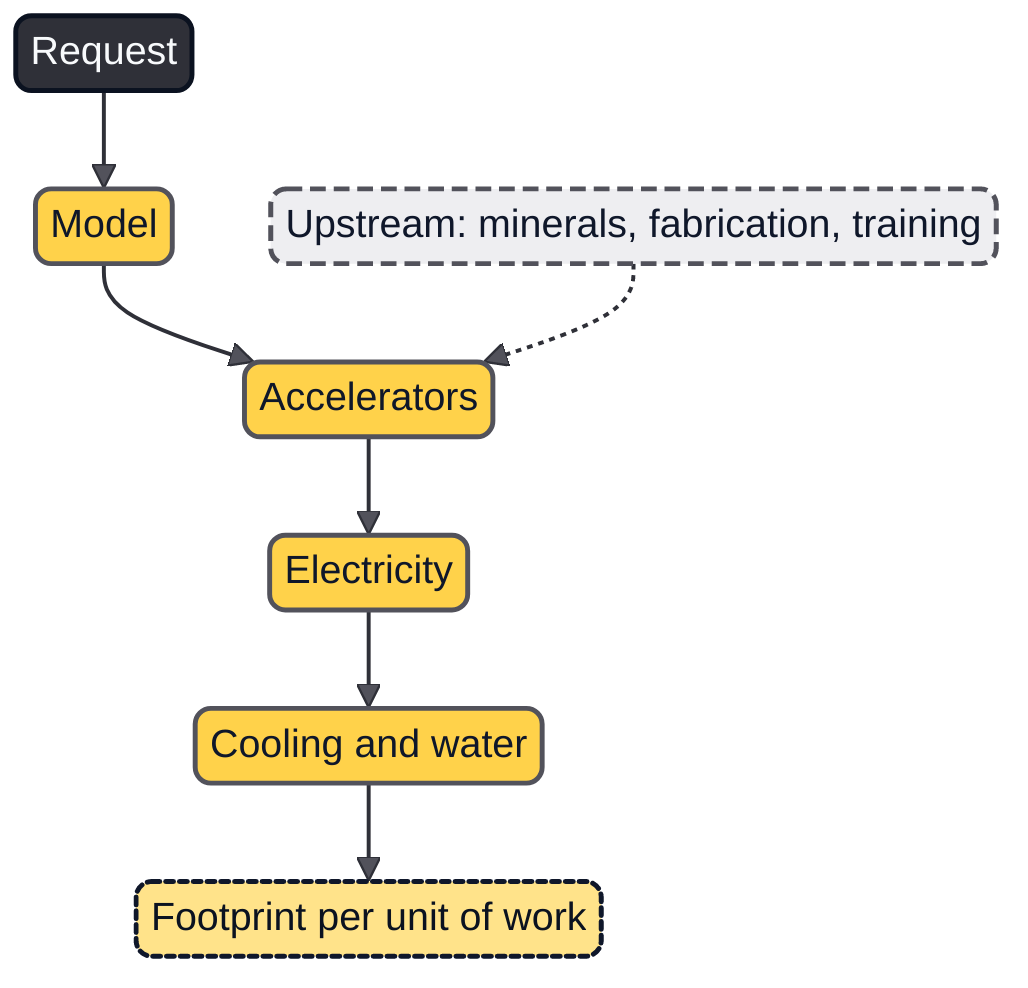
Figure 17.1: An AI request becomes energy, carbon and water through the model, the accelerators, the grid and the cooling system; upstream minerals, fabrication and training add to it.
Table 17.1: Choices that change each step and what is reported.
| Step | Choice that changes the footprint | What is reported |
|---|---|---|
| Request | Routing, caching and output limits | |
| Model | Smallest adequate model | Annex XI model energy documentation (training) |
| Accelerators and servers | Batching and utilisation | |
| Electricity from the grid | Location on a low-carbon grid; timing of flexible work | |
| Cooling, water and waste heat | Cooling design and heat reuse | EED data-centre reporting |
| Footprint per unit of work | Deployer footprint per use case | |
| Upstream: minerals, fabrication, land, training | Hardware lifetime |
Electricity
How much and how fast
The reference estimate comes from the International Energy Agency (IEA), whose report Energy and AI of April 2025 estimated that data centres used around 415 terawatt-hours of electricity in 2024, about 1.5 per cent of global consumption, and projected that their consumption would more than double, to around 945 terawatt-hours, by 2030 in its base case (171, IEA, 2025). AI is the main driver, through accelerated servers whose electricity use grows far faster than that of conventional ones, and by 2030 data centres would account for a little under 3 per cent of global consumption. The IEA stated wide uncertainty between its scenarios, and the International AI Safety Report 2026 notes that estimates rest on incomplete disclosure (50, Bengio et al., 2026).
Where the load lands
A global percentage understates the problem, because the load is concentrated. The IEA expected most of the growth to 2030 in the United States and China, and noted that data centres cluster near fibre and cheap power, so that a region can carry a load that is negligible nationally and decisive locally (171, IEA, 2025). Because a large AI data centre can draw as much power as a town within a few years, while a transmission line takes far longer, the IEA identified grid connection as the binding constraint in several markets. AI Platform and Security, Chapter 22, noted the contrast with the Nordic countries, whose cool climate and low-carbon electricity attract investment (179, Nordqvist, 2026).
Policy is pulling demand up. The Commission's AI Continent Action Plan set out to expand the Union's data-centre capacity substantially through AI factories and gigafactories (13, European Commission, 2025), the proposed Cloud and AI Development Act addresses the permitting and energy needed to host them (14, European Commission, 2026), and the United States made data centres and power a pillar of its AI Action Plan (175, White House, 2025). The footprint is therefore an object of industrial policy as well as a consequence of demand.
Compared with other sectors
On the IEA's figures, data centres account for a modest share of the growth in global electricity demand to 2030, well behind industry, electric vehicles and air conditioning, and their emissions remain a small fraction of global energy-related emissions (171, IEA, 2025). Its timing is nevertheless awkward, because every additional terawatt-hour must be met while the same grids absorb heat pumps, electric vehicles and the electrification of industry. Whether AI delays decarbonisation depends less on its global share than on whether its demand is matched, in the same place and at the same hours, by new clean supply.
Water and materials
Water
The work that made AI's water footprint visible is a paper by Pengfei Li, Jianyi Yang, Mohammad Islam and Shaolei Ren (174, Li et al., 2023). Distinguishing on-site cooling from off-site generation, and withdrawal from consumption, they estimated that training GPT-3 in Microsoft's United States data centres could have evaporated around 700,000 litres of clean freshwater on site, that such a model could consume about half a litre of water for every few tens of responses, varying widely with location and season, and that global AI demand could account for several billion cubic metres of water withdrawal in 2027.
The per-response figure has been widely disputed, because it depends on cooling, climate and generation mix, but the structural findings are robust. Water use varies by location and time, sometimes in the opposite direction to carbon. Water is also local, so a data centre efficient on average can still strain a stressed catchment, and because few operators publish water figures by site, nearby residents often cannot learn what it draws. Closed-loop and liquid cooling use far less water, cool climates allow free-air cooling, and waste heat can feed district heating, as is common in the Nordic countries.
Chips, minerals and land
The materials footprint begins long before the first request. Accelerators are made in a small number of fabrication plants, concentrated in East Asia, that consume large volumes of ultrapure water and energy, and the IEA noted that the refining of some critical minerals used in semiconductors is concentrated in a single country (171, IEA, 2025). Such concentration is a resilience problem as well as an environmental one. The embodied emissions of hardware become a larger share of the footprint as electricity decarbonises, and short replacement cycles add to them and to electronic waste. Emily Bender, Timnit Gebru and colleagues made the distributive point early: the environmental costs of ever larger language models fall on communities often least likely to benefit from them (94, Bender et al., 2021). As Chapter 15 showed, concentration of compute is also concentration of physical demand in a few places.
Training versus inference
Public attention began with training. Emma Strubell, Ananya Ganesh and Andrew McCallum estimated in 2019 that training a large natural-language model, including an extensive architecture search, could emit as much carbon dioxide as several cars over their lifetimes, and recommended that researchers report training time and computational resources (173, Strubell et al., 2019).
Training is a large, one-off cost per model; inference is a small cost per request, multiplied by every request for as long as the model is in service, so for a widely used model it overtakes training (71, Stanford HAI, 2026). Alexandra Sasha Luccioni, Yacine Jernite and Emma Strubell measured inference across many models and tasks and found differences of several orders of magnitude: classifying text used very little energy per request, generating text much more and generating images the most, while multi-purpose generative models used substantially more energy for the same task than task-specific ones (172, Luccioni et al., 2024). Agents that make many calls per task, reasoning models with long intermediate outputs and growing context windows all raise energy per completed task, although the Stanford AI Index documents steep declines in the cost of reaching a given capability (71, Stanford HAI, 2026). The inference footprint is thus the sum of millions of deployer decisions, and those decisions are where most readers can act.
Reporting duties
The Energy Efficiency Directive
The Union's main instrument for data centres is the recast Energy Efficiency Directive, Directive (EU) 2023/1791 (9, European Union, 2023). Article 12 requires Member States to ensure that owners and operators of data centres with an installed IT power demand of at least 500 kilowatts make public each year the information in Annex VII and report it to a European database: floor area, installed power, data traffic, energy consumption, power utilisation, temperature set points, waste-heat utilisation, water use and renewable energy. Article 26 requires data centres with a total rated energy input above one megawatt to use their waste heat unless this is technically or economically infeasible, Article 5 sets public bodies an annual energy-reduction target, and Article 7 requires contracting authorities, above the procurement thresholds, to purchase products, services, buildings and works with high energy-efficiency performance. The implication is that a deployer can now ask for each hosting site's Annex VII figures, and a public authority can make them a procurement criterion.
General-purpose AI documentation
The AI Act addresses energy at the level of the model. Article 53(1)(a) requires providers of general-purpose AI models to keep technical documentation containing at least the information in Annex XI, including the computational resources used for training and the known or estimated energy consumption (1, European Union, 2024). The General-Purpose AI Code of Practice of July 2025 gives the duty a concrete form through a model documentation form with fields for training energy, its estimation method and inference computation (3, European Commission, 2025). Article 40(2) also asks standardisation to address energy-efficient development.
What the duties do not cover
The two regimes leave a gap exactly where the footprint grows. The Energy Efficiency Directive reports buildings, not workloads, so a cloud site's figures say nothing about which share is AI or which customer caused it. The AI Act's documentation concerns the model and runs primarily to the AI Office and national authorities on request, not to deployers. Neither requires anyone to state the energy, carbon or water of an inference request, the quantity a deployer needs to compare two designs. Deployers therefore still estimate, from measured power on their own accelerators and from token counts where they call a hosted model, stating method and limitations (179, Nordqvist, 2026). However, a provider that must estimate a model's energy for the AI Office can be asked for the same estimate in procurement.
Choices that matter
F34 holds that the footprint varies by orders of magnitude with choices, and the research supports it: Luccioni and colleagues measured orders of magnitude between tasks and models (172, Luccioni et al., 2024), Li and colleagues showed that location and time change water use substantially (174, Li et al., 2023), and grid carbon intensity differs by more than an order of magnitude between a hydro-dominated Nordic grid and a fossil-dominated one. The choices fall into five groups. Model size and task: do not use a large general model where a smaller or task-specific one meets the quality objective, the series' principle of choosing the smallest model that meets the acceptance criteria (AI Governance, Chapter 4) (178, Nordqvist, 2026). Routing, caching and limits: route each request to the smallest adequate model, cache recurring answers and cap output length and agent steps. Utilisation: batching and right-sized capacity raise the work done per unit of hardware. Location and time: a low-carbon grid reduces carbon several times over and flexible work can be scheduled for the cleanest hours, weighed against water stress and against sovereignty, which F33 treats as verifiable properties rather than a place (179, Nordqvist, 2026). Hardware and cooling: longer hardware life and efficient, low-water cooling with heat reuse, chosen mostly in procurement.
One caution applies to all five. Lower energy per request lowers cost, and lower cost invites more requests, the rebound effect familiar from energy economics. A budget for the service as a whole, not only an efficiency target per request, makes rebound visible.
Practical guide: Putting a footprint on an AI service
Purpose. Give every significant AI service an estimated footprint and a default to the smallest adequate model.
Roles. The AI system owner owns the footprint record; the platform team operates the gateway and its telemetry; the sustainability manager supplies emission factors; procurement asks providers for their disclosures.
Steps.
- Choose the functional unit the service is managed by, such as a resolved enquiry or a completed agent task.
- Establish adequacy. Run the evaluation suite against at least two model sizes and record the smallest that meets the quality objective for each request class.
- Route by default to the smallest adequate model, escalating only on a declared, logged condition.
- Estimate energy per unit from measured power or token-based estimates, recording the method. Default: report a range where the provider discloses nothing.
- Convert to carbon and water using hourly grid intensity where available and the site's Annex VII water figure.
- Ask the suppliers for Annex VII site figures and Annex XI energy estimates, and record refusals.
- Set an annual energy budget alongside the cost budget.
- Review on change and every six months, since a newer small model often meets an objective that once required a large one.
Definition of done. The service has a footprint record in version control with method and limitations, most requests go to the smallest adequate model, supplier disclosures have been requested and the figures reach the sustainability report. Where a service affects people's rights, quality comes first and the footprint is optimised within it.
Worked example: A routing policy with carbon reporting
The following policy is illustrative. It belongs to Hansa Mutual's shared group AI platform, whose self-hosted and fallback models run in the group data centre in Frankfurt (hansa-dc-frankfurt), and governs the claims assistant used by handlers in the six insurance markets. It extends the gateway routing pattern of AI Platform and Security, Chapter 22, with adequacy evidence, carbon-aware scheduling and a monthly report split by entity.
routing_policy:
  id: RP-HM-CLAIMS-2026-02
  status: illustrative
  service: claims assistant
  decision_record: AIDR-0021
  owner: Head of Group AI Platform
  functional_unit: answered handler query
  default:
    model: small-self-hosted
    site: hansa-dc-frankfurt
    max_output_tokens: 500
    cache: {exact_match: true, ttl_hours: 24}
  routes:
    - class: policy-wording lookup
      model: small-self-hosted
      adequacy_evidence: EVAL-CLAIMS-0412
    - class: multi-document coverage question
      model: medium-self-hosted
      adequacy_evidence: EVAL-CLAIMS-0413, small model below target
    - class: complex coverage dispute
      model: large-hosted
      requires: handler escalation, logged
      provider_disclosure: Annex XI energy estimate requested in contract
  flexible_work:
    jobs: [nightly evaluation runs, correspondence classification backlog]
    schedule: lowest forecast grid carbon intensity within a 12-hour window
  limits: {monthly_energy_budget_mwh: 40}
  reporting:
    cadence: monthly
    split_by: [entity, route]
    metrics: [energy_kwh, co2e_kg_location_based, water_litres_site_estimate, share_of_queries_on_default_model]
    method: measured power on self-hosted nodes, token-based estimate for hosted route
  review:
    triggers: [new model class available, default share below 0.7]
    cadence_months: 6
The adequacy evidence keeps the policy honest: the default is the small model because evaluation shows it is good enough, and the trigger on the default share shows drift towards larger models before it shows in the bill.
The debate
The footprint is measurable, so the disagreement is not about whether electricity and water use are growing but about how much that growth matters relative to other demands and to what AI might contribute in return.
The case for concern
The case for concern starts from the trajectory, not the current share. The IEA's base case has data-centre electricity more than doubling within six years, concentrated where grids are already under pressure (171, IEA, 2025), and governments are actively accelerating the build-out (13, European Commission, 2025) (175, White House, 2025), so growth is a policy goal rather than an accident markets will correct. The footprint also grows where it is hardest to see, in inference, and general-purpose models use far more energy than task-specific ones for the same task (172, Luccioni et al., 2024) while rebound makes efficiency an unreliable defence.
The costs are also local and unequal. Water is drawn from specific, sometimes stressed catchments (174, Li et al., 2023), and Bender and colleagues argued that these costs fall on those least likely to benefit (94, Bender et al., 2021), who often cannot learn their size. Finally, a society that moves public services onto AI builds dependence on a physical system concentrated in a few clusters, fabrication plants and supply chains, the conditions for correlated failure. The concern does not require the machine to stop everywhere, only that capacity be rationed or interrupted when the people who used to do the work no longer can.
The case for calm
The case for calm reads the same IEA report differently. Data centres used about 1.5 per cent of the world's electricity in 2024 and remain a small share and a modest part of demand growth in 2030, well behind industry, electric vehicles and air conditioning (171, IEA, 2025). The cost of inference at a given capability has fallen steeply (71, Stanford HAI, 2026). Arvind Narayanan and Sayash Kapoor's account of AI as a normal technology (60, Narayanan & Kapoor, 2025) applies here: the build-out will meet constraints of finance, permitting and demand, and adjust.
AI is also part of the solution. The IEA devoted much of its report to forecasting renewable output, managing grids and optimising industrial processes (171, IEA, 2025), and the International AI Safety Report notes potential environmental benefits alongside the costs (50, Bengio et al., 2026). As for T8, power stations and fabrication plants are built over years and in public, so a shortage appears as delays, prices and queues long before it could stop a service abruptly; as Chapter 5 argued, the physical economy moves at the speed of construction.
Where the positions meet
Both positions rely on the IEA and accept its central estimates and uncertainty: the global share is small, growth fast, and the local burden near Dublin or stressed water sources can be large. Both accept that inference now dominates growth and that agents and reasoning models raise energy per task. Both accept F34 (179, Nordqvist, 2026) and that measurement is poor, so transparency is the precondition each side needs, and both can support making the Energy Efficiency Directive and Annex XI more useful (9, European Union, 2023) (1, European Union, 2024). And both accept that dependence on concentrated infrastructure is a resilience question whose answer is F33: knowing where workloads run, being able to move them and continuing without them for a time.
What can be done
Individuals can use the smallest tool that does the job, a search for a lookup and image or video generation with awareness that it is the most energy-intensive common task (172, Luccioni et al., 2024), and ask what nearby data centres consume, which larger sites must now publish.
Organisations can give every significant AI service a footprint record, default to the smallest adequate model, schedule flexible work for clean hours, prefer low-carbon hosting with heat reuse, extend hardware life and set a service energy budget. They can ask for Annex VII figures and Annex XI estimates, treat a refusal as information, and record dependence on concentrated capacity as a resilience risk in the AI threat register (Chapter 32).
Society can extend reporting to the share of AI workloads and site-level water in the Commission's review of the data-centre provisions, define comparable per-request figures through standardisation under Article 40 of the AI Act, and require that large new loads come with matching low-carbon supply and heat reuse. The Paris AI Action Summit statement placed environmental sustainability among its priorities (20, AI Action Summit, 2025); comparable disclosure is how that priority becomes checkable. Chapter 28 sets out what Europe has decided more broadly.
Verdict on the trope
T8 The machine that stops, and the humans who forgot. The rise in data-centre electricity use, driven by AI, reaches pattern at scale and is observable. Local strain on grids and water, with connections restricted and projects delayed, reaches incident in the wild in specific regions, and further strain is expected where the build-out outpaces clean supply and grid reinforcement. That concentrated chip fabrication and mineral refining expose AI capacity to correlated interruption stands at the rung of argument. The full form of the trope, a society whose AI stops for physical reasons and that can no longer function without it, remains fiction, and a forecast that it will happen is speculation: physical constraints arrive slowly and visibly, as prices and delays, which gives institutions time to respond.
What can be influenced. An organisation's own footprint is almost entirely within its reach: the model it chooses, how it routes, where and when it runs work and how long it keeps its hardware. Its exposure is within reach too, through the reversibility of its dependence under F33. The pace of the build-out and the planning of grids and water lie beyond any single organisation, but can be influenced through procurement, disclosure and public processes.
Nordvik Region and Hansa Mutual
Nordvik Region's position is favourable, and it can show why. Its citizen-service assistant and other hosted workloads run on two open-weight models on accelerators a European hosting provider reserves for it in a Nordic data centre, on a low-carbon grid, and AI Platform and Security, Chapter 22, set out its carbon calculation (179, Nordqvist, 2026). The provider's site reports under the Energy Efficiency Directive, so the Region asks for its Annex VII figures at each contract review and, under Article 7, weights efficiency and disclosure in its next hosting tender (9, European Union, 2023). It treats energy as a sustainability and procurement matter and links the resilience aspect to THR-NR-05. Asked in the audit committee's work on ATA-NR-2026-01 what the assistants cost in electricity, the Region can answer with a figure and a method.
Hansa Mutual's footprint is larger. Its shared platform in Frankfurt serves seven markets, calls hosted models for some routes and runs two autonomous production agents whose many model calls make energy per completed task the relevant unit. The routing policy above feeds a monthly group sustainability report split by entity, and the group now requests Annex XI estimates and per-request figures from hosted providers. Its resilience concern sits in THR-HM-06, correlated failure of a shared model provider, to which a physical capacity constraint is one more cause. Nordvik's task is to keep a small, clean footprint answerable in public; Hansa's is to keep growth in use from outrunning its gains in efficiency.
Summary
AI has a physical cost in electricity, water, materials and land. The IEA estimated that data centres used about 1.5 per cent of the world's electricity in 2024 and projected that their use would more than double by 2030, with AI the main driver: a modest global share, but large where data centres cluster, and competing with decarbonisation. Water and materials add local and concentrated costs. The footprint has shifted to inference, which varies by orders of magnitude between tasks and models, and that is where deployers can act.
The Energy Efficiency Directive makes larger data centres publish their energy, water and waste-heat figures, and the AI Act requires providers of general-purpose AI models to document energy consumption, but neither reaches the individual request, so deployers estimate and their procurement questions build the market for disclosure. The verdict on T8: growth is observable as a pattern at scale, local strain is an incident in the wild in some regions, and a society whose AI stops for physical reasons remains fiction; dependence can be kept reversible. Chapter 18 opens Part IV, where the threat is what people do with AI, beginning with cyber offence at machine speed.
Sources
- Nordqvist, G. (2026). AI Platform and Security: Building and Securing AI Platforms in European Enterprises and Public Authorities. (179, Nordqvist, 2026)
- Forster, E. M. (1909). The Machine Stops. (33, Forster, 1909)
- International Energy Agency (2025). Energy and AI. (171, IEA, 2025)
- Bengio, Y. et al. (2026). International AI Safety Report 2026. (50, Bengio et al., 2026)
- European Commission (2025). AI Continent Action Plan. (13, European Commission, 2025)
- European Commission (2026). Proposal for a Cloud and AI Development Act (CADA). (14, European Commission, 2026)
- The White House (2025). Winning the Race: America's AI Action Plan. (175, White House, 2025)
- Li, P., Yang, J., Islam, M. A. & Ren, S. (2023). Making AI Less 'Thirsty': Uncovering and Addressing the Secret Water Footprint of AI Models. (174, Li et al., 2023)
- Bender, E. M., Gebru, T., McMillan-Major, A. & Shmitchell, S. (2021). On the Dangers of Stochastic Parrots: Can Language Models Be Too Big? (94, Bender et al., 2021)
- Strubell, E., Ganesh, A. & McCallum, A. (2019). Energy and Policy Considerations for Deep Learning in NLP. (173, Strubell et al., 2019)
- Luccioni, A. S., Jernite, Y. & Strubell, E. (2024). Power Hungry Processing: Watts Driving the Cost of AI Deployment? (172, Luccioni et al., 2024)
- Stanford Institute for Human-Centered Artificial Intelligence (2026). The 2026 AI Index Report. (71, Stanford HAI, 2026)
- European Parliament and Council of the European Union (2023). Directive (EU) 2023/1791 on energy efficiency and amending Regulation (EU) 2023/955 (recast). (9, European Union, 2023)
- European Parliament and Council of the European Union (2024). Regulation (EU) 2024/1689 (Artificial Intelligence Act). (1, European Union, 2024)
- European Commission (2025). The General-Purpose AI Code of Practice. (3, European Commission, 2025)
- Nordqvist, G. (2026). AI Governance: Governing Artificial Intelligence in European Enterprises and Public Authorities. (178, Nordqvist, 2026)
- Narayanan, A. & Kapoor, S. (2025). AI as Normal Technology. (60, Narayanan & Kapoor, 2025)
- AI Action Summit (2025). Statement on Inclusive and Sustainable Artificial Intelligence for People and the Planet. (20, AI Action Summit, 2025)