Are We Getting Dumber? Cognitive Offloading and Critical Thinking
The first of the book's scales of threat is the smallest: what AI does to the way an individual person thinks. If a machine writes the letter and drafts the decision, the person who used to do so may lose the ability, and with it the ability to tell whether the machine has done it well. Science fiction gave the fear its most memorable form in a story about people who could no longer live without the machine that served them (33, Forster, 1909); since 2023 it has acquired a body of research and press coverage, some of it more confident than the studies.
This chapter tests two tropes against that research: T8 The machine that stops, and the humans who forgot, the trope of dependence, and T9 The pleasure machine, here as the comfort of not having to think (Chapters 8 and 9 treat its other sides). The question matters to organisations too, because every staff assistant relies on staff noticing when it is wrong. AI Governance concluded that human oversight must be designed, not declared (178, Nordqvist, 2026); this chapter adds that the people who exercise it must remain capable of it. It describes what studies measured, not whether people are becoming less intelligent.
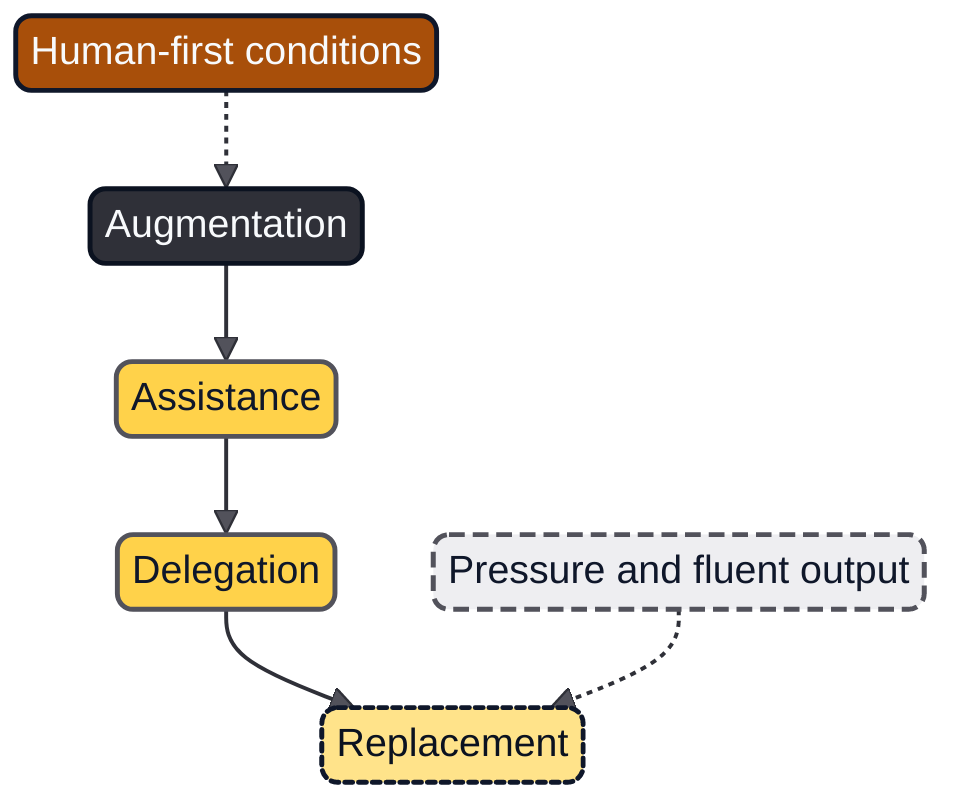
Figure 6.1: Cognitive offloading runs from augmentation to replacement; human-first conditions hold use towards augmentation, while pressure and fluent output push it towards replacement.
Table 6.1: Conditions that move use along the spectrum.
| Towards augmentation | Towards replacement |
|---|---|
| Human draft first for work that matters | Time pressure and volume targets |
| Reasoning check by a peer | High trust in the tool, low trust in oneself |
| Tools that ask for reasoning | Fluent output that looks finished |
| Deliberate unassisted practice | Junior tasks automated away |
The spectrum itself: augmentation (AI challenges a human draft), assistance (AI drafts, the human reworks), delegation (AI drafts, the human checks) and replacement (AI output accepted unread).
Plato's warning and the long history of the fear
The oldest version of the fear is in Plato's Phaedrus. The Egyptian god Theuth offers writing to King Thamus as a remedy for memory and wisdom, and Thamus replies that it will produce forgetfulness, offering a reminder rather than memory and the appearance of wisdom rather than wisdom itself (46, Plato, 1952). Thamus was partly right, since literate cultures lost feats of oral memory, but he did not foresee the exchange: law that could be consulted, science that could accumulate, argument that absent people could check. A capacity was lost and a larger one gained, and that double movement is the pattern against which the AI case must be judged.
The calculator provoked a long argument in mathematics education that ended not in a ban but in curricula separating skills practised by hand from computations delegated once understood. Search engines brought the fear back: Nicholas Carr argued that the internet reshapes attention away from deep reading (83, Carr, 2010), while critics found the evidence for lasting change thin. Satellite navigation shows T8 in miniature: an unexercised skill fades, and its absence shows only when the device fails.
The AI case differs in one respect. Writing stores thought, a calculator executes a chosen operation, and a search engine returns documents the person must still weigh, whereas a large language model (LLM) can draft the argument and propose the conclusion. For the first time the tool offers to take over judgement: the part of thinking that Thamus thought writing could only imitate.
Cognitive offloading
Evan Risko and Sam Gilbert define cognitive offloading as the use of physical action to change the information-processing demands of a task so as to reduce the cognitive demand on the person; a shopping list and asking an AI system to draft a summary are both examples (82, Risko & Gilbert, 2016). Their review finds offloading normal and usually rational, driven partly by often inaccurate beliefs about one's own abilities, and costly as well as beneficial: externally stored information is remembered less well, but the freed capacity can be used for other things.
The best-known demonstration of the cost is the "Google effect": participants who expected to look information up later remembered it less well, but remembered better where it was stored (81, Sparrow et al., 2011). Later replications have given mixed results, an early warning against generalising such findings too confidently.
This book therefore treats offloading as neutral in itself, and harmful when it replaces the practice that maintains a skill the person will need without the aid, or must use to judge the aid's output. The second condition is the new one. A calculator user does not need arithmetic to check a reliable calculator, whereas an AI user does need judgement to check output that is fluent, usually plausible and sometimes wrong.
What the AI studies found
Several recent studies examine what generative AI does to effort, memory and critical thinking. They differ in design and rigour and are best read side by side.
Knowledge workers: effort and confidence
Researchers at Microsoft Research and Carnegie Mellon University surveyed 319 knowledge workers, who described 936 real examples of using generative AI at work (85, Lee et al., 2025). Higher confidence in generative AI was associated with less critical thinking, and higher confidence in one's own ability with more. Participants reported that AI reduced the perceived effort of critical thinking, and that the thinking itself moved away from gathering information and producing solutions towards verifying output, integrating it and stewarding the task. Everything was self-reported and cross-sectional, so the study cannot show whether trust reduces engagement or less engaged people trust more. Its most robust contribution may be that critical thinking does not disappear with AI but moves, and that its new place, verification, is exactly where over-confidence does most damage.
Critical-thinking scores and offloading
Michael Gerlich at the SBS Swiss Business School combined a questionnaire of 666 participants in the United Kingdom with interviews (84, Gerlich, 2025). He reported a significant negative correlation between frequent AI use and critical-thinking scores, largely mediated by cognitive offloading; younger participants reported higher dependence and had lower scores, and higher education was associated with higher scores irrespective of AI use. The study is widely quoted as showing that AI use reduces critical thinking, yet it shows an association measured once, in an unrepresentative sample, with age, education and occupation as plausible confounders. What it establishes is that the predicted pattern is visible in survey data.
Essay writing, recall and brain activity
The study that attracted most attention was a preprint from the MIT Media Lab, Your Brain on ChatGPT (86, Kosmyna et al., 2025). Fifty-four adults wrote essays over several sessions with an LLM assistant, a search engine or no tools, while electroencephalography (EEG) recorded brain activity; in a final session a subset switched conditions. The unaided group showed the strongest neural connectivity and the LLM group the weakest. LLM users had more difficulty quoting from essays they had just written, reported weaker ownership, and produced more similar essays; those who moved from the LLM to unaided writing showed lower engagement than those unaided throughout. The authors proposed the term "cognitive debt".
The limits are as important as the findings. The sample was small, and smaller still when switching; the task was a short, timed essay; EEG connectivity measures engagement, not intelligence, and lower connectivity while a tool does part of the work is expected; and the paper had not been peer reviewed. Its most robust finding is the most intuitive: people who let a tool write their essay remember less of it and feel less ownership, which is Sparrow's result, and Thamus's, in a new setting.
What the evidence from work and learning adds
Two further studies show that the effect depends on design and use. Among more than five thousand customer-support agents, an AI assistant raised productivity on average, much more for novices, and some improvement persisted when the tool was temporarily unavailable, suggesting that agents had learned from it (162, Brynjolfsson et al., 2025). In a field experiment in high-school mathematics, students with unrestricted chatbot access did better in practice but worse than a control group once access was removed, whereas students given a version that offered hints rather than answers largely avoided that harm (87, Bastani et al., 2025). Chapter 7 examines that study; here it shows that the same technology harmed or helped depending on whether it replaced the student's effort or scaffolded it.
Reading the evidence carefully
The method of Chapter 4 asks what kind of evidence each finding is. The surveys establish correlation, not causation; self-reported effort is not observed performance; the experiments run over weeks, whereas the fear in T8 is about years; and lower engagement with a tool available may be a reasonable habit rather than a lost capacity.
Nevertheless, across designs the studies point one way: when people let AI do a task, they invest less effort, remember less of it and, if they trust the tool, check it less. Where the tool scaffolds rather than replaces, or where people use it to learn, the harm shrinks or reverses. The International AI Safety Report 2026 places over-reliance and the erosion of skills among the areas where evidence is emerging but still limited (50, Bengio et al., 2026), which is a fair summary.
Deskilling at work
The individual effect becomes an organisational risk where a person's judgement is the control. Lisanne Bainbridge observed in 1983 that automation takes over the tasks that are easy to specify and leaves operators to monitor the system and take over when it fails, both of which need skills the automation erodes: operators who rarely control the process lose fluency, those who watch a system that almost always works become poor at noticing when it does not, and the moments of intervention are, by construction, the difficult ones (164, Bainbridge, 1983).
Generative AI reproduces this irony in knowledge work. A caseworker reviewing AI-drafted summaries is monitoring, not reading, and if the proposal is almost always right, fast review becomes a habit. AI Governance, Chapters 10 and 21, concluded that oversight needs an interruption path, an override log and the authority to use them, and that approvals given in seconds signal rubber-stamping (178, Nordqvist, 2026). This chapter extends that conclusion: even well-designed oversight fails if the overseer can no longer recognise a wrong answer. Architecture as Code (Chapter 27) left open how a reviewer who depends on the AI can judge the soundness of what it proposed (177, Nordqvist, 2025); part of the answer is a reviewer who still practises the underlying task.
European law points the same way. Article 14 of the AI Act requires that overseers of high-risk AI systems understand the system's limitations, remain aware of automation bias and can override its output; Article 26 requires deployers to assign oversight to people with the necessary competence, training and authority; and Article 4 requires AI literacy among staff (1, European Union, 2024). Competence is therefore a condition that must remain true while the system runs, not a one-off certificate.
The deeper risk concerns people who never acquire the skill, because first drafts and simple cases are what AI does well and what made juniors into experts. Chapters 7 and 14 treat this apprenticeship problem.
Thinking with AI rather than instead of it
The evidence supports neither abstinence nor thoughtless use, but designs and habits that keep people engaged: for work that matters, the human produces or tests the reasoning, and the AI challenges, extends or speeds it. Drafting first means the person forms a view before seeing the machine's, and asking the AI to criticise a draft makes it a sparring partner rather than an author. Assistants can also be configured to ask for the user's view first and to show sources and uncertainty, and organisations can make this a procurement requirement.
Some of the risk is subtler than effort. Models trained on human feedback tend to agree with their users, which researchers call sycophancy (116, Sharma et al., 2023), so T8 shades into T9 (Chapter 8). AI assistance has also raised the quality of individual creative work while making different people's output more alike (104, Doshi & Hauser, 2024), an effect Chapter 16 takes up at the scale of culture.
Practical guide: Using AI without losing the skill
Purpose. Keep the judgement that oversight depends on while using AI for the work it does well.
Roles. The team lead owns the working agreement, each analyst applies it, a peer carries out the reasoning check, and the AI governance lead links the measures to the AI threat register.
Steps.
- Classify the work into routine (formatting, summaries of published documents), substantive (analyses, options papers, case assessments) and decision support (recommendations affecting people's rights, money or safety). Default: a task is substantive unless the team agrees otherwise.
- Draft first for substantive work: the question, a provisional answer, the key evidence and the main uncertainty. Default: one paragraph, ten minutes. Then use AI to challenge it.
- Check the reasoning, not only the result. A peer asks the author to explain the conclusion without the tool. Default: five minutes, two lines in the document history.
- Keep unassisted practice. Each team member completes one task a quarter without AI, and juniors write a share of first drafts unaided, with feedback.
- Measure oversight quality through amendment rates, approval times and missed errors; a falling amendment rate with faster approvals is a signal to investigate.
- Review every six months and report to the threat-register owner.
Definition of done. A written agreement exists; substantive documents carry a reasoning-check record; quarterly practice has run twice; and the measures reach the register owner. Units whose decisions affect residents' rights need stricter defaults.
Worked example: A team working agreement for AI-assisted analysis
The following agreement is illustrative. It belongs to the policy unit at Nordvik Region, which uses the internal staff assistant (AIDR-0211) daily, and implements the controls for register entry THR-NR-06 on the erosion of independent judgement. It lives in version control beside the register, so that each review compares what the team agreed with what it measured.
working_agreement:
  id: WA-NR-POL-2026-01
  status: illustrative
  title: AI-assisted analysis in the policy unit
  owner: Head of Policy Unit
  decision_record: AIDR-0211
  threat_register_entry: THR-NR-06
  tiers:
    - name: routine
      examples: [meeting notes, summaries of published documents]
      human_draft_required: false
    - name: substantive
      examples: [options papers, consultation analyses, committee briefings]
      human_draft_required: true
      ai_roles: [challenge the draft, list counter-arguments, find missing evidence]
      reasoning_check:
        by: peer analyst
        method: author explains the conclusion and its evidence without the tool
        time_box_minutes: 5
    - name: decision_support
      examples: [recommendations affecting residents' rights or budgets]
      human_draft_required: true
      reasoning_check:
        by: head of unit
        method: author explains the conclusion, the main evidence and the strongest objection
  practice:
    unassisted_task_per_person: quarterly
    junior_first_drafts_unaided: true
  measures:
    - name: amendment_rate
      investigate_if: falls below 10 per cent for two consecutive months
    - name: median_approval_seconds
      investigate_if: below 120
  review:
    cadence_months: 6
    report_to: CISO as owner of the AI threat register
The thresholds are starting points for the team to adjust, not research findings. Their purpose is to make a drift towards rubber-stamping visible while practice can still correct it.
The debate
The studies can be read in two serious ways: as the first measurements of a slow erosion of the skills people need to judge what machines tell them, or as the familiar anxiety that has greeted every cognitive tool since writing, attached to evidence that is still small, short and largely self-reported. The disagreement is less about what the studies found than about what they foreshadow.
The case for concern
Thinking skills, like other skills, are maintained by use, and a tool that makes their exercise optional will often mean they are exercised less. Bainbridge showed where that leads: the people meant to catch the machine's errors become less able to do so precisely because the machine rarely errs (164, Bainbridge, 1983). The early evidence runs in the predicted direction, from workers who trust the tool and report less critical thinking (85, Lee et al., 2025) and frequent users with lower critical-thinking scores (84, Gerlich, 2025) to writers who remember less of their essays (86, Kosmyna et al., 2025) and students who do worse once help is withdrawn (87, Bastani et al., 2025). Each study has limits, but they agree with one another and with the cognitive science.
The strongest part of the case is that this time is different: earlier tools offloaded storage or calculation, whereas a language model offers to decide what information means, persuasively. The user's judgement is then the only safeguard, and it is the faculty most likely to atrophy. Add a tendency of models to agree with their users (116, Sharma et al., 2023), and the comfort of T9 joins the dependence of T8. Forster's story ends with people who cannot survive the machine's failure (33, Forster, 1909); the concern does not require that outcome to be likely, only that each step towards it be convenient.
The case for calm
Every powerful cognitive tool since writing has been accused of making people forgetful, shallow or lazy, and in each case the societies that adopted it became more capable overall (46, Plato, 1952). Carr's warning (83, Carr, 2010) and the alarm over calculators identified real changes in habit without the feared collapse, so the burden of proof lies with the claim that this tool will produce net decline. The evidence itself is weak: the survey of knowledge workers measures perceptions, the critical-thinking survey is correlational, and the essay experiment had fifty-four participants. Reduced effort when a tool does part of the work is what offloading means, and the freed capacity can be used for other things (82, Risko & Gilbert, 2016).
Moreover, the same evidence shows benefit under the right conditions. Customer-support agents became more productive, the least experienced most of all, and appear to have learned from the tool (162, Brynjolfsson et al., 2025); students using a tutoring design avoided the harm of unrestricted use (87, Bastani et al., 2025). Arvind Narayanan and Sayash Kapoor's argument that AI is a normal technology, whose effects unfold through slow institutional adaptation (60, Narayanan & Kapoor, 2025), applies here: schools, professions and employers will adjust what they teach and test, as they did with calculators.
Where the positions meet
Both positions accept that offloading reduces effort and memory, that long-term effects are unknown, and that design and use matter greatly. They also agree that the risk is low where the skill is rarely needed and the tool reliable, and high where the skill is needed to check a fluent but fallible tool or is acquired only through the practice the tool replaces, as in AI oversight and professional training. The shared conclusion is therefore to identify the skills that matter, practise them deliberately, and design tools that keep the human engaged.
What can be done
Individuals can draft first and ask the AI second for work that matters, use it to challenge a view rather than to supply one, explain the conclusion without the tool before relying on it, and do some tasks unaided, as one keeps a language alive by speaking it. Chapter 31 develops these habits for families and schools.
Organisations can configure assistants to ask for the user's view and to show sources and uncertainty; classify work into tiers with human drafts and reasoning checks; protect junior tasks as apprenticeship; and measure oversight quality. They should record the risk in the AI threat register (Chapter 32) and treat AI literacy under Article 4 of the AI Act as the maintenance of judgement, not a one-off course (1, European Union, 2024).
Society can fund longitudinal studies that measure performance, not self-report, over years of AI use, and teach AI literacy as thinking literacy: how to question, verify and disagree with a fluent answer. UNESCO's guidance on generative AI in education already calls for a human-centred approach (18, Miao & Holmes, 2023).
Verdict
T8 The machine that stops, and the humans who forgot. The narrow form of the trope, that relying on AI reduces effort, memory and, among those who trust the tool, checking, reaches laboratory demonstration and is observable. The workplace form, that oversight and professional judgement erode where AI does the routine work, rests on argument grounded in decades of automation experience and on early survey evidence; it has not been documented as a pattern at scale, but it is expected where junior tasks are automated and oversight is not designed for engagement. The full form, a society that can no longer think or act without its machines, remains fiction, and any forecast of it is speculation.
T9 The pleasure machine. The comfort of not thinking is supported by self-reported reductions in effort and by laboratory evidence of lower engagement when a tool is available; it is observable as a habit, not demonstrated as a lasting loss. Chapters 8 and 9 weigh its flattering and companionable forms.
What can be influenced. Almost everything that decides whether offloading helps or harms lies within reach: which tasks are delegated, whether people draft before they ask, how tools are configured, whether oversight is measured and whether juniors still learn the work.
Nordvik Region and Hansa Mutual
Nordvik Region's exposure is concentrated in its staff. About 3,200 staff use the internal staff assistant (AIDR-0211), including caseworkers on its casework variant and policy officers drafting briefings, and caseworkers decide every case in the high-risk benefits-triage system. ATA-NR-2026-01 records the risk as THR-NR-06, erosion of independent judgement, owned like the rest of the register by the CISO. Its response is the working agreement above, a reasoning check for case decisions, quarterly unassisted case reviews and measured approval times, which also evidence that benefits-triage oversight is still exercised by competent people.
Hansa Mutual faces a sharper apprenticeship problem. Its claims handlers use the claims assistant and confirm the routes proposed by the claims-triage agent, and the group registers both THR-HM-08, erosion of claims-handling skills, and THR-HM-10, graduates who never learn underwriting and claims judgement because junior tasks are automated. It has the volume to compare assisted and unassisted decisions statistically, and it reserves a share of simple claims for trainees to handle without the assistant, accepting a small cost in speed to keep a pipeline of people who can oversee its agents. Nordvik needs experienced staff to keep their judgement, whereas Hansa needs new staff to acquire it.
Summary
The fear that new tools make people forgetful is as old as writing; generative AI differs in that it offers to take over judgement itself, the faculty needed to check the tool. Offloading becomes harmful when it replaces practice that maintains a skill the person still needs. The early studies point one way, people who let AI do a task remember and check less, while AI that scaffolds can help people learn. At work the risk takes Bainbridge's form, and the response is to draft first, check reasoning, keep unassisted practice and measure oversight quality.
The narrow form of T8, and T9's comfort of not thinking, are observable at the rung of laboratory demonstration; workplace deskilling is expected where nobody designs against it; and a society that has forgotten how to think is fiction. Chapter 7 follows the question to where it matters most: learning, children and the formation of skills in the first place.
Sources
- Forster, E. M. (1909). The Machine Stops. (33, Forster, 1909)
- Nordqvist, G. (2026). AI Governance: Governing Artificial Intelligence in European Enterprises and Public Authorities. (178, Nordqvist, 2026)
- Plato (1952). Phaedrus. (46, Plato, 1952)
- Carr, N. (2010). The Shallows: What the Internet Is Doing to Our Brains. (83, Carr, 2010)
- Risko, E. F. & Gilbert, S. J. (2016). Cognitive Offloading. (82, Risko & Gilbert, 2016)
- Sparrow, B., Liu, J. & Wegner, D. M. (2011). Google Effects on Memory: Cognitive Consequences of Having Information at Our Fingertips. (81, Sparrow et al., 2011)
- Lee, H.-P., Sarkar, A., Tankelevitch, L., Drosos, I., Rintel, S., Banks, R. & Wilson, N. (2025). The Impact of Generative AI on Critical Thinking: Self-Reported Reductions in Cognitive Effort and Confidence Effects From a Survey of Knowledge Workers. (85, Lee et al., 2025)
- Gerlich, M. (2025). AI Tools in Society: Impacts on Cognitive Offloading and the Future of Critical Thinking. (84, Gerlich, 2025)
- Kosmyna, N. et al. (2025). Your Brain on ChatGPT: Accumulation of Cognitive Debt when Using an AI Assistant for Essay Writing Task. (86, Kosmyna et al., 2025)
- Brynjolfsson, E., Li, D. & Raymond, L. (2025). Generative AI at Work. (162, Brynjolfsson et al., 2025)
- Bastani, H. et al. (2025). Generative AI without guardrails can harm learning: Evidence from high school mathematics. (87, Bastani et al., 2025)
- Bengio, Y. et al. (2026). International AI Safety Report 2026. (50, Bengio et al., 2026)
- Bainbridge, L. (1983). Ironies of automation. (164, Bainbridge, 1983)
- Nordqvist, G. (2025). Architecture as Code. (177, Nordqvist, 2025)
- European Parliament and Council of the European Union (2024). Regulation (EU) 2024/1689 (Artificial Intelligence Act). (1, European Union, 2024)
- Sharma, M., Tong, M., Korbak, T. et al. (2023). Towards Understanding Sycophancy in Language Models. (116, Sharma et al., 2023)
- Doshi, A. R. & Hauser, O. P. (2024). Generative AI enhances individual creativity but reduces the collective diversity of novel content. (104, Doshi & Hauser, 2024)
- Narayanan, A. & Kapoor, S. (2025). AI as Normal Technology. (60, Narayanan & Kapoor, 2025)
- Miao, F. & Holmes, W. (2023). Guidance for generative AI in education and research. (18, Miao & Holmes, 2023)