Culture, Creativity and the Homogenisation of Thought
Culture is the slowest of the shared goods that Part III examines, and the hardest to measure. A society's stories, images, music and turns of phrase are made by many people over long periods, each borrowing from the others and adding something new. Generative AI enters that process at both ends: it is trained on the accumulated output of human culture, and it now produces a growing share of what people read and see. This chapter asks whether a tool that has learned from everything makes people more creative, or pulls what they make towards the average of everything it learned.
The chapter tests two tropes from Chapter 2. T9 The pleasure machine is the trope of comfort that crowds out effort, which Aldous Huxley gave a cultural form: the World State of Brave New World keeps its citizens content with synthetic entertainment and has given up difficult art as the price of stability (34, Huxley, 1932). T8 The machine that stops, and the humans who forgot here takes the form of creative skills and livelihoods that fade once a machine supplies the first draft. It matters to every authority that publishes in more than one language and every company that writes marketing copy, because each now decides, often unnoticed, whose work its tools were trained on. The chapter also answers part of Q11, because several cultural harms attributed to generative AI began earlier, with recommendation systems.
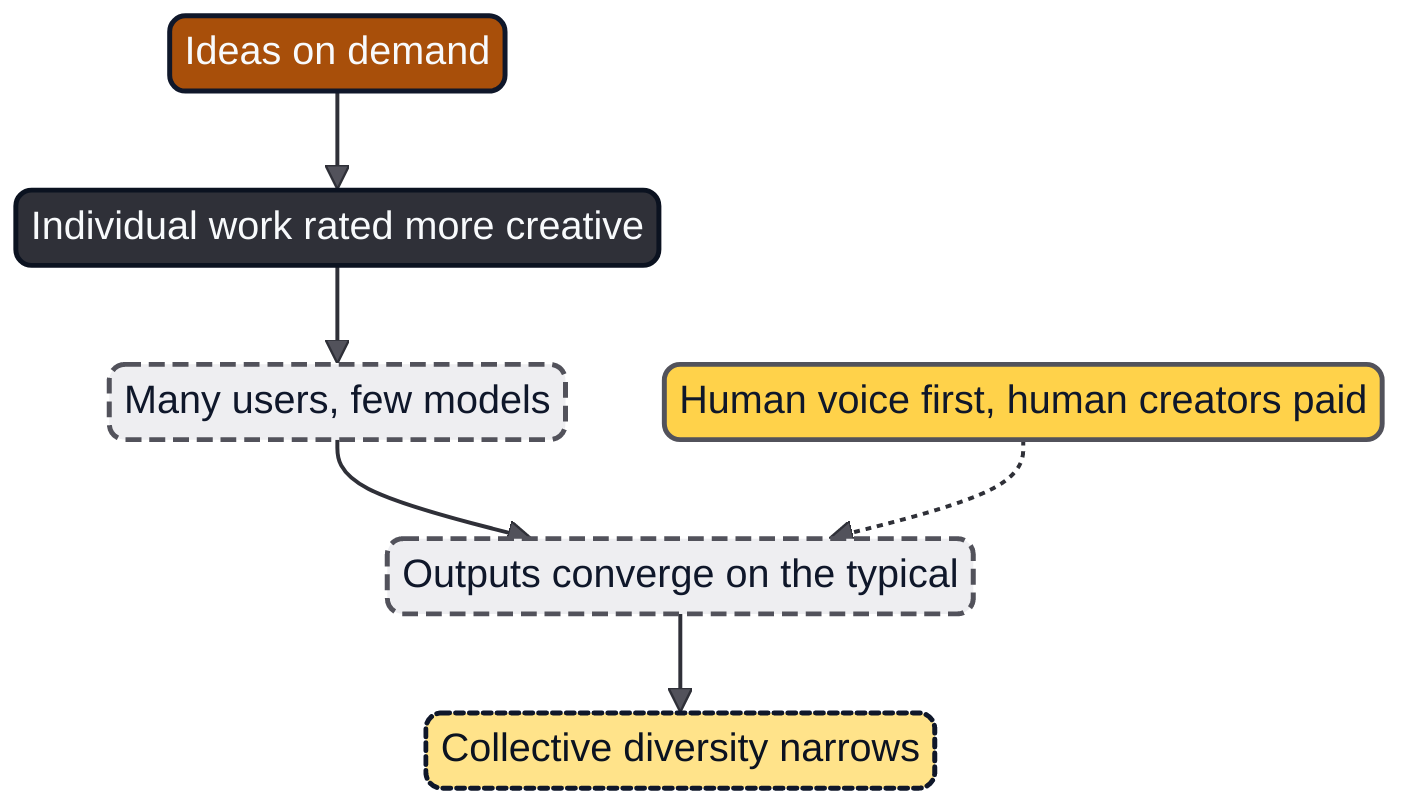
Figure 16.1: Generative AI raises the rated creativity of individual work while many users drawing on the same few models narrows collective diversity.
Table 16.1: Measures that counteract the narrowing.
| Measure | Acts on |
|---|---|
| Human voice first, AI as instrument | Convergence of outputs |
| Respect opt-outs and credit human work | Thinning of rare styles, views and languages |
| Training-data transparency in procurement | Many users drawing on the same few models |
| Fund small-language data and models | Thinning of rare styles, views and languages |
| Commission and pay human creators | Narrowing of collective diversity |
More creative, less diverse
The clearest experimental evidence comes from Anil Doshi and Oliver Hauser, published in Science Advances in 2024 (104, Doshi & Hauser, 2024). Participants wrote a very short story, either unaided or with one or up to five story ideas from a large language model, and evaluators who did not know the condition rated the stories for novelty, usefulness and enjoyment. Access to AI ideas raised the rated creativity of individual stories, most of all for the writers who had scored lowest on a creativity test, whose stories were rated close to those of the most creative writers working unaided. At the same time, stories written with AI ideas were more similar to one another. The authors described a social dilemma: each individual is better off using the tool, while the collective loses some of the novelty that comes from people starting in different places. It is a single experiment with very short stories and one model, and it measured people taking ideas from a model, not using one to criticise their own.
Other evidence points the same way. In the MIT Media Lab essay experiment examined in Chapter 6, essays written with an LLM assistant were more similar to one another than those written with a search engine or without tools, and their authors felt less ownership of them (86, Kosmyna et al., 2025). The mechanism is simple: a model trained to predict likely continuations tends, unless configured otherwise, to offer those most typical of its training data, so two writers who accept its suggestions converge. In customer support, an AI assistant raised novices' productivity most by spreading the practices of the best workers (162, Brynjolfsson et al., 2025), and there convergence on best practice is the purpose. In creative work it is part of the cost, because the value of a story or an argument lies partly in its difference from the others.
The average of everything
When researchers at Stanford introduced the term foundation models in 2021, they named homogenisation as a defining property: a few models, adapted to many tasks, become the common base of a great many applications, and their defects and biases propagate with them (93, Bommasani et al., 2021). The same structure applies to culture once millions of people write, draw and translate with the same few models.
Style
Homogenisation of style is the most visible effect: text drafted with chat assistants shares a recognisable register, balanced, fluent and fond of lists of three, and image generators produce a polished default that is good enough for many commercial users. A style that becomes common also becomes cheap, and human work moves towards what models handle less well, as painting moved away from realistic portraiture once photography could supply it. That adaptation is a reason for calm, but it depends on people who can still afford to develop a different style.
Opinion
Homogenisation of opinion is harder to observe and more consequential, because an assistant that suggests the next sentence also suggests a position. Models trained on human feedback tend to agree with the views their users express (116, Sharma et al., 2023), which flatters each user without widening anyone's view. And Emily Bender, Timnit Gebru and colleagues warned that very large web-scraped datasets over-represent those who write most online, so that models encode a dominant view while appearing neutral (94, Bender et al., 2021). The risk is a gradual narrowing of the opinions people meet while forming their own; Jan Kulveit and colleagues include culture among the systems in which incremental delegation could erode human influence (167, Kulveit et al., 2025), an argument Chapter 26 weighs.
Language
Homogenisation of language is the effect most specific to Europe. Models perform best in the languages that dominate their training data, mostly English, and DeepMind researchers list lower performance for some languages among the forms of exclusion such models produce (70, Weidinger et al., 2022). For a small language this can mean poor writing, fallback to a neighbouring majority language or dialect flattened into a standard form. Ilia Shumailov and colleagues further showed that models trained recursively on generated data degrade, losing first the tails of the original distribution, the rare and unusual (97, Shumailov et al., 2024). A small language whose online text is increasingly machine output therefore risks feeding the next models a flattened version of itself.
What ordinary automation did first
For Q11, which asks which machine harms have already happened without advanced AI, culture offers a clear answer. Recommendation systems on music and video platforms, search-engine optimisation and engagement-driven ranking have shaped what is made and heard for more than a decade, the mechanism of T9 driven by ordinary automation. Generative AI extends the same logic from the distribution of culture to its production.
Creative work and its economics
Writing, translation, illustration and related occupations are among the most exposed to generative AI. Tyna Eloundou and colleagues found that occupations involving writing skills are more susceptible to exposure, and that exposure is higher on average in better-paid occupations, contrary to earlier evaluations of machine-learning exposure (157, Eloundou et al., 2024), while the International Labour Organization finds most exposed occupations more likely to be transformed than replaced (159, Gmyrek et al., 2025). Chapter 14 examines the labour market as a whole; three features are specific to creative work.
First, many creative workers are freelancers paid by the piece, so substitution falls immediately on individual incomes, as translators experienced with machine translation. Second, creative work depends on audiences finding it, and Pew Research Center found that Google users were considerably less likely to click a link when an AI-generated summary appeared at the top of the results (101, Chapekis & Lieb, 2025); for creators whose income depends on traffic, an answer assembled from their work but read elsewhere is a direct loss. Third, if AI raises less experienced creators towards the most experienced, the premium for experience may shrink. That helps new entrants, but a junior illustrator or translator who never gets the routine commissions may never acquire the craft: T8 in its creative form.
Institutions have begun to respond. After the 2023 strike of the Writers Guild of America, the guild's agreement with the studios provided that AI cannot write or rewrite literary material, that AI-generated material is not source material under the agreement and that writers cannot be required to use AI tools. In Europe, Articles 18 to 20 of the Directive on copyright in the Digital Single Market give authors and performers the principle of appropriate and proportionate remuneration, a right to information about exploitation and a mechanism to adjust disproportionately low remuneration (8, European Union, 2019); they were written for publishing contracts, not training data, but express a principle of fair sharing. Daron Acemoglu and Simon Johnson argue that whether a technology benefits workers depends on its direction, automation or augmentation, and on who has the power to shape it (67, Acemoglu & Johnson, 2023).
Consent and copyright
Beneath the economic question lies the legal one: whether those whose work trained the models consented and should be paid. What follows describes architectural implications, not legal advice.
The text-and-data-mining exception
The Directive on copyright in the Digital Single Market defines text and data mining in Article 2 as any automated analytical technique aimed at analysing text and data in digital form to generate information such as patterns, trends and correlations (8, European Union, 2019). Article 3 lets research organisations and cultural heritage institutions mine lawfully accessible works for scientific research, and Article 4 allows mining by anyone, for any purpose, on lawfully accessible works, but under Article 4(3) only if the rightholder has not expressly reserved the use in an appropriate manner, such as machine-readable means for content made publicly available online. Article 4 therefore creates an opt-out system. The AI Act settled for providers of general-purpose AI models the debated question whether training is mining in this sense by building on Article 4(3) directly, although what counts as an appropriate reservation is not yet settled by the Court of Justice.
The opt-out requires each rightholder to act in a technical form before the crawl, is hard to apply to copies posted by others and does not remove a work from a model already trained. Public authorities face a choice of their own, because openness may help a small language become better represented in future models.
What the AI Act adds
The AI Act turns the opt-out into a compliance obligation. Article 53(1)(c) requires every provider of a general-purpose AI model to put in place a policy to comply with Union copyright law, in particular to identify and comply with, including through state-of-the-art technologies, a reservation of rights under Article 4(3) of the Directive, and Article 53(1)(d) requires a sufficiently detailed public summary of the training content, according to an AI Office template (1, European Union, 2024). The recitals apply the copyright obligation to any provider placing a model on the Union market, wherever the training took place. Article 53(2) exempts free and open-source models from some documentation duties, but not from these two. The obligations fall on the provider, so a deployer cannot discharge them but can ask for the evidence; the Commission's guidelines explain when an organisation that modifies a model becomes its provider (4, European Commission, 2025).
Article 50 also requires machine-readable marking of synthetic output and disclosure of deep fakes, in a form that does not hamper evidently artistic or fictional work (1, European Union, 2024), and in June 2026 the Commission published a code of practice on marking and labelling (5, European Commission, 2026).
The General-Purpose AI Code of Practice of July 2025 is a voluntary instrument with chapters on transparency, copyright, and safety and security (3, European Commission, 2025). Its copyright chapter commits signatories to crawl only lawfully accessible content without circumventing paywalls, to respect machine-readable reservations including the robots exclusion protocol, to reduce infringing output and to offer rightholders a complaints mechanism. Not every provider signed every chapter, but the Code gives deployers a list of what to ask for.
What remains unresolved
The European framework addresses consent through transparency and opt-out, but it does not settle remuneration: nothing requires payment for works mined lawfully because no reservation was expressed. Licensing markets are developing, but most works in existing models were collected before they existed. Attribution is unresolved, since an output cannot generally be traced to the works that most influenced it, and the opt-out works only prospectively.
Small languages and cultures
The European Union has twenty-four official languages, and Europe many regional and minority languages, from Basque and Welsh to the Sámi languages, for many of which models are poor because too little digital text is openly available. An authority serving residents in a minority language through an AI assistant may give them a worse service or push them towards the majority language, and published text from a model that writes a small language badly degrades the material from which people and future models learn. The UNESCO Recommendation on the Ethics of Artificial Intelligence asks member states to consider AI's effects on linguistic diversity and to use AI to help preserve endangered languages (17, UNESCO, 2021).
National libraries and research groups have trained models on national corpora, and the Commission's AI Continent Action Plan names computing infrastructure and access to high-quality data for AI innovators as the first two of its five key domains (13, European Commission, 2025). AI Platform and Security, Chapter 13, argues that digital sovereignty is a set of verifiable properties (179, Nordqvist, 2026); for a small language, one of those properties is whether any model serves it well at all. Because much of the best text is held by publishers and archives, initiatives that work combine public funding, licensing on agreed terms and governance in which the language community takes part.
Supporting human creativity
Institutions need not wait for the law to settle. They can keep human voice in work whose value lies in its difference, credit and pay for human work, and make training-data transparency and copyright compliance a condition of procurement, the main lever a deployer holds over a provider, as AI Governance, Chapter 7, argued for procurement generally (178, Nordqvist, 2026), testing every language with native speakers before signature.
Worked example: A procurement clause on training-data transparency and opt-out compliance
The following clause is illustrative. It belongs to Nordvik Region's framework procurement of generative AI services, recorded in decision record AIDR-0416, and is kept in version control beside the tender documents.
procurement_clause:
  id: PC-NR-GENAI-2026-03
  status: illustrative
  decision_record: AIDR-0416
  related_threat_entries: [THR-NR-05, THR-NR-08]
  applies_to: generative AI services built on general-purpose AI models
  provider_evidence:
    - id: copyright_policy
      basis: AI Act Article 53(1)(c)
      requirement: copyright policy covering rights reservations under Directive (EU) 2019/790 Article 4(3)
    - id: training_content_summary
      basis: AI Act Article 53(1)(d)
      requirement: public summary of training content in the AI Office template
      due: with tender response, and within 30 days of any new model version
    - id: code_of_practice
      requirement: status under the transparency and copyright chapters, or equivalent evidence
  opt_out_compliance:
    machine_readable_reservations: honoured, including the robots exclusion protocol
    rightholder_complaints: named contact and response time stated in the contract
  output_safeguards:
    indemnity: provider indemnifies Nordvik against third-party copyright claims arising from outputs
  labelling: {basis: AI Act Article 50(2), requirement: machine-readable marking of generated content}
  language_requirements:
    - {language: national language, evaluation: native-speaker review before signature}
    - {language: regional minority language, evaluation: native-speaker review before signature, fallback: human translation}
  reserved_for_humans: [cultural commissions, minority-language publications, campaign concepts]
  review: at each model change and at least annually
The clause does not make Nordvik responsible for the provider's training, which it cannot control; it makes the provider's compliance a condition of the contract and keeps the evidence where the audit committee can see it.
The debate
The same evidence that shows collective output converging shows individual work improving, and creative communities are divided between those who see a threat to their livelihood and those who see a new instrument.
The case for concern
Drawing on a model for ideas makes collective output converge (104, Doshi & Hauser, 2024), and the same arithmetic applies to a culture when hundreds of millions use a handful of models, which concentrate first drafts in systems whose defaults propagate everywhere (93, Bommasani et al., 2021), encode the most common views and idioms (94, Bender et al., 2021), favour large languages (70, Weidinger et al., 2022) and, under recursive training, lose the rare first (97, Shumailov et al., 2024). Moreover, models trained on creators' work, mostly without consent or payment, now compete with them while AI summaries draw audiences away (101, Chapekis & Lieb, 2025), so the supply of new human work and the apprenticeship that renews it may shrink.
The deepest version is Huxley's. The World State did not ban art; it made art unnecessary by supplying something more comfortable (34, Huxley, 1932), as the passengers of WALL-E are entertained without effort and have lost the capacity to want anything else (43, Stanton, 2008). An endless supply of competent, personalised content needs no villain for that effect, and Kulveit and colleagues describe how such shifts can erode human influence over culture without anyone deciding to give it up (167, Kulveit et al., 2025).
The case for calm
The case for calm starts from history. Photography was expected to destroy painting and recorded music live performance; each displaced some work and enabled art that could not otherwise have existed. The same experiment shows that AI raised the least experienced writers most (104, Doshi & Hauser, 2024), giving new voices, such as people with disabilities or writing in a second language, means that were once expensive. Diversity among those who create may therefore rise even if average output converges, and the experiment measured only the latter.
Audiences also value evidently human work, and labelling helps them tell the two apart (1, European Union, 2024). Arvind Narayanan and Sayash Kapoor's view of AI as a normal technology whose effects unfold through institutional adaptation (60, Narayanan & Kapoor, 2025) fits culture well: collective agreements, licensing markets and the AI Act's copyright obligations arrived within a few years.
Where the positions meet
Both positions accept that AI raises the rated quality of individual work for many users, that outputs drawn from the same model converge, and that the long-term effect on culture is unknown. Both accept that the outcome depends on use: AI as a source of finished ideas pulls towards the average, AI as an instrument need not. They also agree that consent, attribution and remuneration are unresolved and that the opt-out of Article 4(3) protects future works better than past ones (8, European Union, 2019), while training-data transparency and respect for reservations are workable measures already promoted by the AI Act and the Code of Practice (3, European Commission, 2025). Diversity of styles, views and languages will not be preserved by the market alone.
What can be done
Individuals can start from their own idea before asking for the model's, use the model to criticise and vary rather than to originate, keep some creative practice unassisted, and seek out and pay for human work, including in small languages. Creators can reserve their rights in machine-readable form. Chapter 31 develops such habits further.
Organisations can make provider copyright evidence a condition of procurement, as in the clause above, evaluate every language served, reserve cultural commissions for paid, credited human authors, disclose AI-generated content honestly and record the decisions in the AI threat register (Chapter 32).
Society can hold providers to Article 53, clarify whether remuneration should follow lawful mining, fund open resources for small languages and keep funding human creative work for its own sake, as the UNESCO Recommendation asks (17, UNESCO, 2021).
Verdict
T9 The pleasure machine. The cultural form of the trope, that machine-supplied content makes creative effort less necessary and pulls what people make towards a comfortable average, reaches laboratory demonstration: drawing ideas from a model raises individual quality while narrowing collective diversity. The shaping of creative production by engagement-driven recommendation, part of the answer to Q11, is observable without any generative AI, and the homogenisation of generated style is observable in everyday use but not yet measured as a pattern at scale. A culture that has given up difficult art for synthetic comfort remains fiction, and any forecast that it will arrive is speculation.
T8 The machine that stops, and the humans who forgot. Economic pressure on freelance creative work, visible in translation, is observable in individual markets but not documented as a pattern at scale. The loss of creative apprenticeship is expected, supported by argument from earlier automation and by the levelling evidence, wherever organisations replace junior commissions with generated work. The flattening of small languages through recursively generated text is shown as a mechanism by laboratory demonstration and is expected where little curated text exists and nobody invests in it.
What can be influenced. Individuals choose whether AI is an instrument or a substitute; organisations choose what they procure, commission from people and serve in which languages; society decides whether obligations are enforced and creators share in the value their work generates.
Nordvik Region and Hansa Mutual
Nordvik Region publishes public information in the national language and a regional minority language with little digital text. Its threat assessment, ATA-NR-2026-01, handles homogenisation and copyright through procurement and cultural policy, linked to THR-NR-05, dependence on a small number of model and hosting providers, and THR-NR-08, loss of trust in the Region's public information through synthetic content. Decision AIDR-0416 adopts the clause above, requires native-speaker evaluation in both languages, keeps human translation where model quality is insufficient, and funds digitising and licensing minority-language material on terms agreed with authors and the language community.
Hansa Mutual's exposure is commercial. Its marketing teams use generative tools in the languages of its seven markets, so its concern is its own voice: copy drafted with competitors' tools converges and generated images may resemble protected works. Its response mirrors Nordvik's, with provider evidence through group procurement, an indemnity clause, native-speaker review in each market and a rule that campaign concepts and brand identity are commissioned from human creatives. Nordvik protects a culture and a language; Hansa protects a brand voice and its legal position across seven jurisdictions.
Summary
The best experimental evidence shows a double effect: drawing on a model for ideas raises the rated creativity of individual work, most of all for the least experienced, while making different people's work more alike. Homogenisation runs through style, opinion and language, a process recommendation systems began, and creative apprenticeship is at risk.
European law addresses consent through transparency and opt-out: Article 4 of the Directive on copyright in the Digital Single Market permits mining unless rights are reserved, and Article 53 of the AI Act requires providers to honour reservations and summarise their training content, while remuneration and attribution remain unresolved. The cultural pleasure machine reaches laboratory demonstration, a culture that has given up difficult art remains fiction, and the loss of creative skills is expected where organisations replace human commissions without thought. Chapter 17 turns to the energy, water and materials that AI consumes.
Sources
- Huxley, A. (1932). Brave New World. (34, Huxley, 1932)
- Doshi, A. R. & Hauser, O. P. (2024). Generative AI enhances individual creativity but reduces the collective diversity of novel content. (104, Doshi & Hauser, 2024)
- Kosmyna, N. et al. (2025). Your Brain on ChatGPT: Accumulation of Cognitive Debt when Using an AI Assistant for Essay Writing Task. (86, Kosmyna et al., 2025)
- Brynjolfsson, E., Li, D. & Raymond, L. (2025). Generative AI at Work. (162, Brynjolfsson et al., 2025)
- Bommasani, R. et al. (2021). On the Opportunities and Risks of Foundation Models. (93, Bommasani et al., 2021)
- Sharma, M., Tong, M., Korbak, T. et al. (2023). Towards Understanding Sycophancy in Language Models. (116, Sharma et al., 2023)
- Bender, E. M., Gebru, T., McMillan-Major, A. & Shmitchell, S. (2021). On the Dangers of Stochastic Parrots: Can Language Models Be Too Big? (94, Bender et al., 2021)
- Kulveit, J., Douglas, R., Ammann, N., Turan, D., Krueger, D. & Duvenaud, D. (2025). Gradual Disempowerment: Systemic Existential Risks from Incremental AI Development. (167, Kulveit et al., 2025)
- Weidinger, L., Uesato, J., Rauh, M., Griffin, C. et al. (2022). Taxonomy of Risks posed by Language Models. (70, Weidinger et al., 2022)
- Shumailov, I., Shumaylov, Z., Zhao, Y., Papernot, N., Anderson, R. & Gal, Y. (2024). AI models collapse when trained on recursively generated data. (97, Shumailov et al., 2024)
- Eloundou, T., Manning, S., Mishkin, P. & Rock, D. (2024). GPTs are GPTs: Labor market impact potential of LLMs. (157, Eloundou et al., 2024)
- Gmyrek, P. et al. (2025). Generative AI and Jobs: A Refined Global Index of Occupational Exposure. (159, Gmyrek et al., 2025)
- Chapekis, A. & Lieb, A. (2025). Google users are less likely to click on links when an AI summary appears in the results. (101, Chapekis & Lieb, 2025)
- European Parliament and Council of the European Union (2019). Directive (EU) 2019/790 on copyright and related rights in the Digital Single Market. (8, European Union, 2019)
- Acemoglu, D. & Johnson, S. (2023). Power and Progress: Our Thousand-Year Struggle Over Technology and Prosperity. (67, Acemoglu & Johnson, 2023)
- European Parliament and Council of the European Union (2024). Regulation (EU) 2024/1689 (Artificial Intelligence Act). (1, European Union, 2024)
- European Commission (2025). Guidelines on the scope of the obligations for general-purpose AI models established by Regulation (EU) 2024/1689 (AI Act). (4, European Commission, 2025)
- European Commission (2026). Commission publishes Code of Practice on marking and labelling AI-generated content. (5, European Commission, 2026)
- European Commission (2025). The General-Purpose AI Code of Practice. (3, European Commission, 2025)
- UNESCO (2021). Recommendation on the Ethics of Artificial Intelligence. (17, UNESCO, 2021)
- European Commission (2025). AI Continent Action Plan. (13, European Commission, 2025)
- Nordqvist, G. (2026). AI Platform and Security: Building and Securing AI Platforms in European Enterprises and Public Authorities. (179, Nordqvist, 2026)
- Nordqvist, G. (2026). AI Governance: Governing Artificial Intelligence in European Enterprises and Public Authorities. (178, Nordqvist, 2026)
- Stanton, A. (2008). WALL-E. (43, Stanton, 2008)
- Narayanan, A. & Kapoor, S. (2025). AI as Normal Technology. (60, Narayanan & Kapoor, 2025)