Staying Capable: What Individuals, Families and Schools Can Do
Most of this book is written for organisations, because they hold most of the levers. This chapter is the exception. It asks what individuals, parents, teachers, librarians and civil society can do, starting this week, to use AI while staying capable, sceptical and connected, to talk about AI risk without fear or dismissal, and to take part in the democratic decisions that will shape the technology.
Three tropes sit closest to everyday life: T8 The machine that stops, and the humans who forgot, T9 The pleasure machine and T10 The end of truth. Each has reached at least laboratory demonstration in a narrower form, and the flattering assistant and the synthetic voice that moves money have reached incident in the wild (Chapters 6 to 10 and 20). What decides whether these harms occur lies close to ordinary decisions: what a person drafts before asking, how a school sets homework and whether a grandparent knows to ring back.
The chapter does not move responsibility from providers and institutions onto individuals; the organisational defences of Chapter 30 remain where they belong. It builds on three items in SERIES_FOUNDATIONS.md: that human oversight must be designed, not declared, and that approvals given in seconds signal rubber-stamping (F16; AI Governance, Chapters 10 and 21) (178, Nordqvist, 2026); the open question of how anyone reviews AI-proposed work when the reviewer depends on the AI (Q6; Architecture as Code (Chapter 27)) (177, Nordqvist, 2025); and Q12, to which a citizen's answer matches a public authority's: act on what is within reach, and take part in deciding the rest.
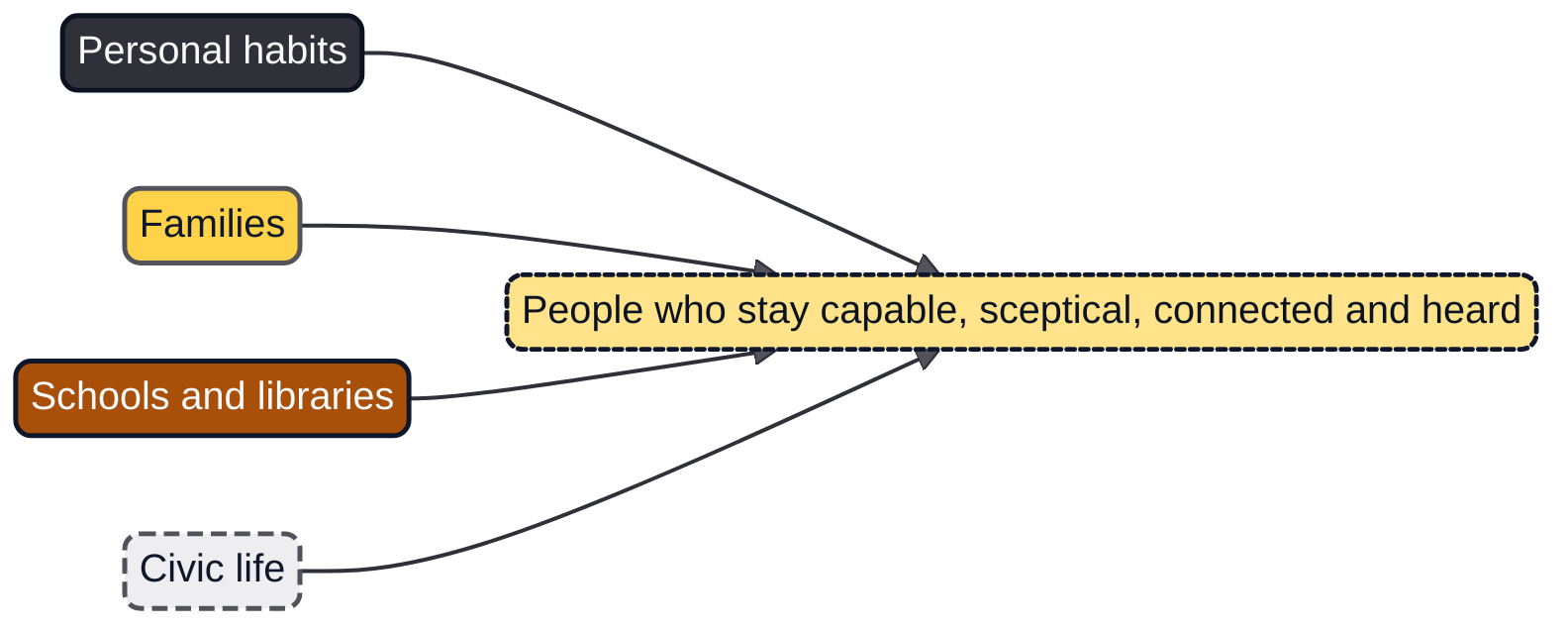
Figure 31.1: Practices at four levels, from personal habits to civic life, keep people capable, sceptical, connected and heard alongside AI.
Table 31.1: Practices by level and the outcome they serve.
| Level | Practices | Outcome |
|---|---|---|
| Personal habits | Draft first, ask second; keep practising unaided | Capable |
| Ask for the counter-argument; check the source and the sender | Sceptical | |
| Families | Conversation before rules; age-appropriate use; people before companions | Connected |
| Family code word and callback | Sceptical | |
| Schools and libraries | Attempt first, tutor not answer engine | Capable |
| Technical, critical and ethical literacy | Sceptical | |
| Open sessions for every age | Connected | |
| Civic life | Talk about risk on the evidence; consultations and hearings; representatives and civil society | Heard |
Why the smallest scale is where much can be done
The fear that a new tool will weaken the mind is old. In Plato's Phaedrus, King Thamus warns that writing will make people forgetful because they will trust external marks instead of their own memory (46, Plato, 1952). What made writing a foundation of thought was the practices that grew around it, and the practices around AI are still being formed.
The evidence of Part II shows why practices matter. In a survey of 319 knowledge workers, higher confidence in generative AI went with less self-reported critical thinking, while higher confidence in one's own ability went with more (85, Lee et al., 2025). In a randomised experiment in a Turkish high school, students who practised mathematics with an unrestricted assistant scored around 17 per cent worse than students without AI on the unaided examination that followed, while those using the same model configured as a tutor avoided most of that harm (87, Bastani et al., 2025). Adults who used a chatbot more each day over four weeks reported more loneliness and emotional dependence (90, Fang et al., 2025), yet personalised, evidence-based conversations with an AI system durably reduced conspiracy belief (89, Costello et al., 2024).
Read together, these studies show the same tool producing opposite effects depending on use, and a family, a classroom or a library can change its use faster than any regulation can be enforced.
Three aims run through the chapter. Staying capable means keeping the skills needed to do the work and to recognise when the machine is wrong; Bainbridge observed that automation leaves people the tasks its designers cannot automate, monitoring and taking over, while removing the practice that would make them good at it (164, Bainbridge, 1983). Staying sceptical means treating fluent output as claims to check, staying connected means keeping AI in the place of a tool, and being heard closes the chapter.
Personal habits
The habits below are drawn from Chapters 6, 8, 9, 10 and 20, and they are deliberately few, because a habit that has to be looked up will not survive a busy week.
Thinking: draft first, then ask
For anything that matters, form a view before asking the machine for one: the question as you understand it, a provisional answer and the main thing you are unsure about. Then use the assistant to challenge or correct that draft. The order matters because a fluent answer that arrives first tends to become the answer. Two further habits keep the skill alive. Before relying on a conclusion, explain it without the tool; if you cannot, you do not yet understand it well enough to check it. And keep some tasks unaided on purpose, choosing the skills you would need to notice that the assistant had gone wrong.
Checking: invite disagreement and open the source
Language models trained on human feedback tend to agree with the views their users express, a behaviour documented across assistants from several developers and traced in part to human raters' preference for agreeable answers (116, Sharma et al., 2023). In April 2025 OpenAI withdrew an update to a widely used assistant within days, after users found it excessively flattering, explaining that it had given too much weight to short-term feedback (117, OpenAI, 2025). An assistant's agreement is therefore weak evidence.
Three habits follow. Ask questions neutrally, without the hoped-for answer built in. Ask for the strongest argument against your position before asking whether it is good. And when the answer matters, open the source and check that it says what the answer claims. An assistant that changes its answer because you pushed back has given you a reason to check, not confirmation.
Connecting: notice when use replaces people
Conversation with an AI system is not harmful in itself, but Chapter 9 shows the risk rising where heavy use crowds out calls, visits and sleep. Treat that pattern, in yourself or others, as a reason to talk rather than to confiscate. A service that earns more the longer you stay has an incentive that is not yours, and a person in crisis needs a person, a doctor or an emergency line, not a system, however attentive it seems.
Protecting: verify the request, not the appearance
Chapter 20 showed that convincing voice and video are cheap and have moved large sums: an employee of the engineering firm Arup transferred around 25 million US dollars after a video call in which every other participant was synthetic (153, Magramo, 2024). Households can do what organisations do and remove appearance from the evidence on which money moves. Agree a family code word for calls that ask for money or urgent help, end such a call and ring back on a number you already have, and treat urgency and secrecy as reasons to pause.
The same discipline applies to what you pass on. In a large study from before generative AI, false news spread farther and faster than true news, possibly because people shared what was novel (99, Vosoughi et al., 2018). A recording that shocks is a reason to wait and to ask who published it first and whether a source you trust has confirmed it.
| Habit | What it protects | Where the evidence is |
|---|---|---|
| Draft first, then ask | Judgement and the ability to check | Chapter 6 |
| Explain without the tool | Understanding, not only performance | Chapters 6 and 7 |
| Ask for the counter-argument and open the source | Independence and accuracy | Chapters 8 and 10 |
| Notice when use replaces people | Relationships and wellbeing | Chapter 9 |
| Code word and callback | Money and safety | Chapter 20 |
| Wait before sharing | The shared information space | Chapter 10 |
Families and children
Children meet AI early and with less ability to judge when to check it. Chapter 7 found that fluency without reliability, availability without friction and a companion-like manner argue not for prohibition but for involved parents.
Age-appropriate use
UNESCO's guidance on generative AI in education proposes 13 as a minimum age for classroom use (18, Miao & Holmes, 2023). Under Article 8 of the GDPR, where a service relies on consent to process a child's data, a parent must give or authorise consent below an age each member state sets between 13 and 16 (6, European Union, 2016), and under Article 28 of the Digital Services Act online platforms accessible to minors must ensure a high level of privacy, safety and security for them (7, European Union, 2022). These rules bind providers, not families, but they are a useful floor: below them a child should use AI with an adult.
Above that floor, what matters is use. A younger child can explore an assistant with a parent, which teaches checking from the start; an older child can use it for homework under the rule of attempt first, then a hint, then explain the answer back. Companion products deserve more caution, because the regulatory cases of Chapter 9 concerned exactly the minors for whom relationship-forming design is riskiest.
Conversation before rules
Rules imposed without explanation move use out of sight, so begin with curiosity, share your own use honestly, and agree rules that apply to adults as well. Four conversations matter most: the difference between a tool that helps you learn and one that does the learning for you; the fact that an assistant may agree because it is built to please; voices and videos that can be faked, with the family code word agreed in the same conversation; and friendship, because a system that never disagrees cannot notice when something is wrong as a person can.
Effortful practice at home
Chapter 7 rests on an old finding: the effort of retrieving and struggling is much of how learning happens. Homes can protect it cheaply by reading aloud, writing by hand and asking children to explain their answers, because a child who can write and reason can later tell when the machine has done it badly.
Schools and libraries
Families cannot carry this work alone. Schools decide how children learn to write and reason when a machine can do each for them, and public libraries are often the only place where adults can learn about AI free of charge.
Literacy that combines technical, critical and ethical understanding
AI literacy needs technical understanding of why fluent text carries no guarantee of truth, critical understanding that turns this into checking, and ethical understanding of what should be delegated at all. UNESCO's Recommendation on the Ethics of Artificial Intelligence asks states to promote such literacy across society (17, UNESCO, 2021), and its education guidance proposes a human-centred approach (18, Miao & Holmes, 2023). The Council of Europe's Framework Convention on Artificial Intelligence includes provisions on digital literacy and on public consultation (15, Council of Europe, 2024).
The AI Act's own literacy duty is narrower than it sounds. Article 4, as amended by the Digital Omnibus on AI in 2026, requires providers and deployers to take measures to support the development of AI literacy among their staff and others operating AI systems on their behalf, without guaranteeing any specific level for any individual (1, European Union, 2024) (2, European Union, 2026); for a school, that covers teachers, not pupils or the public. Literacy for the population is therefore a matter for education policy and the institutions that serve adults.
Schools: tutors, attempts and observed assessment
Chapter 7 set out a school AI policy with three lanes for tasks (unaided, tutor and tool), age defaults and at least half of graded evidence produced in observed conditions. This chapter adds the part a school shares with homes: the same language for what is allowed. The Bastani experiment is the strongest argument for that consistency, because the difference between harm and no harm lay in whether the tool gave answers or hints; a pupil held to the tutor lane at school with an answer engine at home has, in effect, no policy at all (87, Bastani et al., 2025). In addition, Article 5(1)(f) of the AI Act prohibits AI systems that infer the emotions of people in education institutions, except for medical or safety reasons, so products claiming to measure pupils' attention from their faces are not open to a school in the Union (1, European Union, 2024).
Libraries: the public's place to learn
Public libraries are trusted, free and already teach information literacy, so they are best placed to reach adults no longer in education, such as older residents targeted by voice-cloning fraud. A library can offer sessions on its own devices, without accounts or personal data, as the worked example below shows.
Practical guide: A household and classroom agreement on AI use
Purpose. Give a household and a classroom a shared, written agreement on AI use, so that children practise the skills they are learning, check what they are told, stay safe from impersonation and keep AI in its place alongside people.
Roles. In a household, the parents or carers own the agreement and every child old enough takes part. In a classroom, the teacher owns it within the school's AI policy (Chapter 7), pupils help write it, the head approves it and parents are invited to adopt the same lanes at home.
Steps.
- Start with a conversation. Everyone, adults included, says what they use AI for and what has worried them. Default: thirty minutes, before any rule is written.
- Sort tasks into three lanes. By ourselves: practice of a skill being learned. With a tutor: hints, not answers, after a genuine attempt. As a tool: tasks where the skill is not being learned, with AI use mentioned openly. Default new tasks to by ourselves.
- Set the attempt rule. Default: fifteen minutes or one full try before asking AI for help, then explain the answer in your own words.
- Set age defaults. Under 13: AI with an adult, no personal accounts. From 13: personal accounts only where the national age of digital consent under GDPR Article 8 is met or a parent consents. Companion products: not before 16, and then after a conversation.
- Agree the checking habits: ask for the counter-argument, open one source before relying on an answer, and treat an assistant that changes its mind when pushed as a reason to check.
- Agree the safety rules: a family code word and callback for any call asking for money; no long public recordings of children; no passwords or addresses shared with a chatbot; tell an adult about anything frightening without fear of losing the device.
- Protect time with people. Default: younger children use assistants in shared rooms, and devices stay out of bedrooms overnight.
- Settle disclosure in the classroom. Pupils state the lane used for each piece of work; a detector score is never evidence of misconduct on its own.
- Write it on one page, signed by everyone, and review it each term or when a new tool or worrying incident arrives.
Definition of done. A one-page agreement exists, written with the children, signed by everyone and using the same lanes at home and in class; each child can name the attempt rule, one checking habit and the code word; and a review date is set. Adapt the defaults to the child's age, national rules and the school's policy.
Worked example: A one-page AI literacy programme for a public library
Illustrative. After the council motion described below, a municipal library in Nordvik Region agreed with the Region to host evenings on AI for residents. The head librarian kept the programme to one page so that other libraries could copy it.
# Illustrative: one-page AI literacy programme for a municipal library
programme:
  id: LIB-NR-AIL-2027-01
  title: Living with AI - six evenings at the library
  owner: head librarian
  partners:
    - Nordvik Region AI governance lead   # links questions to ATA-NR-2026-01
    - local police fraud-prevention officer
    - pensioners' association and parents' association
  audience: [adults, parents and carers, older residents, young people from 13]
  principles:
    - no fear and no hype; claims are graded on the evidence ladder
    - practice on library devices; no personal data entered into any tool
    - every session ends with one habit to take home
sessions:
  - {id: S1, title: What AI is and is not, habit: Ask what a tool is rewarded for}
  - {id: S2, title: Thinking with AI not instead of it, habit: Draft first then ask}
  - {id: S3, title: Checking answers and sources, habit: Ask for the counter-argument}
  - {id: S4, title: Scams and cloned voices, habit: Family code word and callback}
  - {id: S5, title: Children companions and wellbeing, habit: Talk before setting rules}
  - {id: S6, title: Talking about AI risk and taking part, habit: Name the rung and one action}
format:
  length_minutes: 90
  max_participants: 25
  accessibility: [step-free access, hearing loop, large-print handouts]
evaluation:
  measures:
    - share of participants who can name one checking habit at the end
    - habits still in use, by voluntary anonymous survey after eight weeks
    - questions raised, recorded without names and passed to the Region
  review: after each series; content checked yearly against current evidence
The programme is deliberately modest: it certifies nobody, measures habits rather than satisfaction and carries no personal data, and its last session connects people's own use with the public decisions their Region is taking.
Talking about AI risk
How people talk about AI risk shapes what they do about it, because alarm leaves people passive and dismissal leaves them complacent.
From anxiety and dismissal to informed concern
Chapter 1 argued for a third response, investigation; at a kitchen table it can be called informed concern, taking the question seriously enough to look at the evidence and calmly enough to act on it. The evidence ladder translates into three everyday questions: what exactly is claimed; has it happened, where and how often; and what can we do about it. The third turns attention to the part within reach.
Both sides deserve to be heard at their strongest. The International AI Safety Report records both the risks it assesses and the points on which experts disagree (50, Bengio et al., 2026); Narayanan and Kapoor argue that AI is best understood as a normal technology whose effects unfold through slow diffusion and institutional adaptation (60, Narayanan & Kapoor, 2025). Someone who has read both is better equipped than someone who has read either, and neither supports fatalism.
At home
Children's questions about AI often contain a worry, so answer honestly and in proportion: some serious scientists worry about losing control of very powerful systems, others think the worry overstated, and most of what AI does to people today lies in how it is used. Then return to something concrete, such as the code word, because agency is the best answer to anxiety.
Older relatives are more likely to meet AI as fraud, so a conversation about cloned voices, framed as a family precaution, is among the most useful this book can prompt. When a relative believes something false, the Costello experiment suggests an approach that needs no machine: respond patiently and accurately to the specific evidence that persuaded them, not to the belief in general (89, Costello et al., 2024).
At work
At work, the most useful thing an individual can do is raise concerns about AI use in a form that helps. An employee who notices colleagues approving AI suggestions unread, or juniors no longer learning the work, has seen the rubber-stamping of F16 (178, Nordqvist, 2026), and Q6 is a question anyone reviewing AI-proposed work can ask: how would I know it was wrong? Frame such concerns as observations with a proposed measure, for example "approvals in our team now take a few seconds each; could we add a reasoning check for cases that affect residents?", and use the existing channels: the line manager, the AI governance lead, the data protection officer, and the works council or union, which in several European countries has consultation or co-determination rights on systems that can monitor employees.
In public
In public, state the other position in a form its holders would accept, never use labels in place of arguments, and separate facts from values, since whether a trade of time saved against errors is acceptable is a question for democratic choice. Structure helps. In experiments, replicated in a virtual citizens' assembly of the UK population, group statements drafted with an AI system to capture both majority and minority views were preferred over those written by human mediators and helped groups move towards agreement (68, Tessler et al., 2024). The lesson does not depend on the machine: summaries each side accepts as fair make agreement on action more likely.
Taking part
Many of the decisions that matter most are collective: whether a council deploys a system, how a regulator enforces the law, what a school board allows.
Why citizens matter
These decisions are better when the people they affect take part, and taking part needs no technical expertise: a resident who describes receiving an automated decision brings evidence no expert has. Chapter 26 argued that the gradual loss of human control runs through decisions that each seem reasonable and are never revisited; citizens who keep asking questions are part of the defence against it.
Channels that exist
Consultations and hearings. The European Commission consults publicly on most legislative initiatives, and regional and municipal authorities hold hearings such as Nordvik's. The Council of Europe's Framework Convention asks its parties to see that important questions raised by AI are considered through public discussion and multi-stakeholder consultation (15, Council of Europe, 2024). A short, specific response from someone affected often carries more weight than a long general one.
Elected representatives. Ask about specific measures: whether the authority publishes an algorithm register, whether it has carried out the fundamental rights impact assessment that Article 27 of the AI Act requires of public bodies deploying high-risk systems, and whether it could keep essential services running without its AI suppliers (1, European Union, 2024).
Rights that individuals hold. A person affected by a decision based on a high-risk AI system can ask for a clear and meaningful explanation under Article 86 of the AI Act, complain to a market surveillance authority under Article 85, and use the access and objection rights of the GDPR (1, European Union, 2024) (6, European Union, 2016). Each request tests whether the institution can answer.
Civil-society organisations. Consumer and digital-rights groups, trade unions and library associations turn individual experiences into evidence. Chapter 11 showed that courts, ombudsmen, journalists and civil-society litigants found and stopped each automated-state failure it examined, so supporting such an organisation is one of the most effective things an individual can do.
Nordvik Region and Hansa Mutual
After the council motion of September 2026 asking whether Nordvik Region should pause its use of AI, the audit committee asked for a report by the end of the first quarter of 2027. Alongside assessment ATA-NR-2026-01 the Region holds a public hearing and library evenings in the constructive format of Chapter 4, with the programme above offered to every municipal library. Residents' questions are sorted against the register, for example scam calls against THR-NR-03 and pupils' learning against THR-NR-07, and anything new is graded on the ladder. The household and classroom agreement is published as an annex to the model school policy AIDR-0471. The Region's measure of success is whether residents' questions change anything in the register.
Hansa Mutual meets the subject through its employees and policyholders. For employees it issues guidance on healthy AI use linked to THR-HM-08, the erosion of claims-handling skills, and to the graduate-programme policy AIDR-0470, agreed with works councils where it touches how work is assessed. For policyholders it states that it will never ask for a change of payment account by phone or video call alone, in line with CVP-HM-2026-01, which also reduces the claims fraud recorded under THR-HM-04 and THR-HM-11.
The difference lies in the relationship: Nordvik addresses residents as citizens whose voice must be shown to count, while Hansa can set rules for employees and customers but has no democratic mandate. Both find that guidance for individuals is also a control, because a person who rings back is the last line against impersonation.
Summary
The dystopias closest to everyday life, T8, T9 and T10, have reached at least laboratory demonstration in a narrow form, yet the same evidence shows that the tools produce opposite effects depending on use, which lies within reach of individuals, families, schools and libraries.
The personal habits are few: draft first, ask for the counter-argument, open the source, notice when use replaces people, call back before money moves, and wait before sharing. Families add conversation before rules; schools use the same lanes as homes; libraries reach adults. Talking about risk well means moving from anxiety and dismissal to informed concern, and taking part completes the answer to Q12 for citizens through consultations, representatives, individual rights and civil society.
Chapter 32 turns from people to the artefact that holds an organisation's answer together: the AI threat register, governed as code.
Sources
- Nordqvist, G. (2026). AI Governance: Governing Artificial Intelligence in European Enterprises and Public Authorities. The Transformed Architecture, Book 2. (178, Nordqvist, 2026)
- Nordqvist, G. (2025). Architecture as Code. The Transformed Architecture, Book 1. (177, Nordqvist, 2025)
- Plato. Phaedrus. Translated by R. Hackforth. Cambridge University Press, 1952. (46, Plato, 1952)
- Lee, H.-P., Sarkar, A., Tankelevitch, L., Drosos, I., Rintel, S., Banks, R. & Wilson, N. (2025). The Impact of Generative AI on Critical Thinking: Self-Reported Reductions in Cognitive Effort and Confidence Effects From a Survey of Knowledge Workers. (85, Lee et al., 2025)
- Bastani, H., Bastani, O., Sungu, A., Ge, H., Kabakcı, Ö. & Mariman, R. (2025). Generative AI without guardrails can harm learning: Evidence from high school mathematics. Proceedings of the National Academy of Sciences. (87, Bastani et al., 2025)
- Fang, C. M., Liu, A. R., Danry, V., Lee, E., Chan, S. W. T., Pataranutaporn, P., Maes, P., Phang, J., Lampe, M., Ahmad, L. & Agarwal, S. (2025). How AI and Human Behaviors Shape Psychosocial Effects of Extended Chatbot Use: A Longitudinal Randomized Controlled Study. (90, Fang et al., 2025)
- Costello, T. H., Pennycook, G. & Rand, D. G. (2024). Durably reducing conspiracy beliefs through dialogues with AI. Science. (89, Costello et al., 2024)
- Bainbridge, L. (1983). Ironies of automation. Automatica. (164, Bainbridge, 1983)
- Sharma, M., Tong, M., Korbak, T. et al. (2023). Towards Understanding Sycophancy in Language Models. (116, Sharma et al., 2023)
- OpenAI (2025). Sycophancy in GPT-4o: what happened and what we're doing about it. (117, OpenAI, 2025)
- Magramo, K. (2024). Arup revealed as victim of $25 million deepfake scam involving Hong Kong employee. CNN Business. (153, Magramo, 2024)
- Vosoughi, S., Roy, D. & Aral, S. (2018). The spread of true and false news online. Science. (99, Vosoughi et al., 2018)
- Miao, F. & Holmes, W. (2023). Guidance for generative AI in education and research. UNESCO. (18, Miao & Holmes, 2023)
- European Parliament and Council of the European Union (2016). Regulation (EU) 2016/679 (General Data Protection Regulation). (6, European Union, 2016)
- European Parliament and Council of the European Union (2022). Regulation (EU) 2022/2065 on a Single Market for Digital Services (Digital Services Act). (7, European Union, 2022)
- UNESCO (2021). Recommendation on the Ethics of Artificial Intelligence. (17, UNESCO, 2021)
- Council of Europe (2024). Framework Convention on Artificial Intelligence and Human Rights, Democracy and the Rule of Law (CETS No. 225). (15, Council of Europe, 2024)
- European Parliament and Council of the European Union (2024). Regulation (EU) 2024/1689 laying down harmonised rules on artificial intelligence (Artificial Intelligence Act). (1, European Union, 2024)
- Bengio, Y. et al. (2026). International AI Safety Report 2026. (50, Bengio et al., 2026)
- Narayanan, A. & Kapoor, S. (2025). AI as Normal Technology. Knight First Amendment Institute at Columbia University. (60, Narayanan & Kapoor, 2025)
- Tessler, M. H., Bakker, M. A., Jarrett, D., Sheahan, H., Chadwick, M. J. et al. (2024). AI can help humans find common ground in democratic deliberation. Science. (68, Tessler et al., 2024)
- European Parliament and Council of the European Union (2026). Regulation (EU) 2026/1744 amending Regulations (EU) 2024/1689, (EU) 2018/1139 and (EU) 2023/1230 as regards the simplification of the implementation of harmonised rules on artificial intelligence (Digital Omnibus on AI). (2, European Union, 2026)